Keragaman Genetik Tetua Dan Anakan Dari Kebun Benih Semai Acacia Mangium Grup D (Am004) Di Sumatera Selatan, Indonesia
DOI:
https://doi.org/10.18330/jwallacea.2014.vol3iss2pp129-137Keywords:
Keragaman genetik, kebun benih semai Sumatera Selatan, tetua, anakan, penanda mikrosatelitAbstract
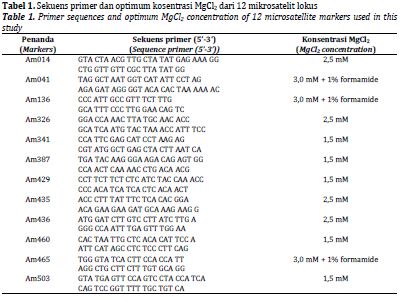
Informasi keragaman genetik dari satu generasi ke generasi selanjutnya merupakan faktor penting untuk pengelolaan dan konservasi genetik kebun benih. Tujuan dari penelitian ini adalah untuk mengevaluasi tingkat keragaman genetik tetua sebagai generasi pertama (F1) dan anakannya (F2) dari kebun benih Akasia mangium yang ada di kebun benih semai Grup D (AM004) di Sumatera Selatan. Analisis dilakukan terhadap 251 tetua dan ± 200 biji dari 10 pohon induk. Analisis menggunakan 12 penanda mikrosatelit menunjukkan bahwa rata-rata jumlah alel yang terdeteksi (A) dari semua tetua dan anakannya adalah 8,23 dan 7.08. Secara umum, tingkat keragaman genetik tetua dan anakan tidak berbeda (He=0.609 untuk tetua dan He=0.606 untuk anakan). Penelitian ini mendeteksi keberadaan alel baru pada anakan. Kondisi ini menunjukkan kemungkinan adanya kontaminasi serbuk sari dari luar kebun benih.
References
Beadle, C., K. Barry, E. Hardiyanto, R. Irianto, Junarto,
C. Mohammed and A. Rimbawanto. (2007). Effect
of pruning Acacia mangium on growth, form and
heart rot. Forest Ecology and Management, 238
(1-3), 261-267.
Butcher, P.A., S. Decroocq, Y. Gray and G.F. Moran.
(2000). Development, inheritance and crossspecies
amplification of microsatellite markers
from Acacia mangium. Theor Appl Genet, 101,
-1290.
Butcher, P.A., C. Harwood and T.H. Quang. (2004).
Studies of mating systems in seed-stands suggest
possible causes of variable outcrossing rates in
natural populations of Acacia mangium. Forest
Genetics, 11, (3-4), 303-309.
Chezhian, P., R. Yasodha, M. Ghosh. (2010). Genetic
diversity analysis in a seed orchard of Eucalyptus
tereticornis. New Forests, 40(1), 85-99.
Don, R.H., P.T. Cox, B.J. Wainwright, K. Baker and J.S.
Mattick. (1991). 'Touchdown' PCR to circumvent
spurious priming during gene amplification.
Nucleic Acids Research, 19, 4008.
Eyles, A., C. Beadle, K. Barry, A. Francis, M. Glen and C.
Mohammed. (2008). Managmenet of fungal rootrot
pathogens in tropical Acacia mangium
plantations. Forest pathology, 38(5), 332-355.
Griffin, A.R., T.D Vuong, J.L. harbard, C.Y. Wong, C.
Brooker and R.E. Vaillancourt. (2010). Improving
controlled pollination methodology for breeding
Acacia mangium willd. New Forests, 40,131-142.
Hansen, O.K. dan E.D. Kjaer. (2006). Paternity analysis
with microsatellites in a Danish Abies
nordmanniana clonal seed orchard reveals
dysfunctions. Canadian Journal of Forest
Research, 36 (4):1054-1058.
Irianto, R.S.B., K. Barry, N. Hidayati, S. Ito, A. Fiani, A.
Rimbawanto and C. Mohammed. (2006).
Incidence and spatial analysis of root rot of
Acacia mangium in Indonesia. Journal of Tropical
Forest Science, 18 (3):157-165.
Jones, T.H., D.A. Steane, R.C. Jones, D. Pilbeam, R.E.
Vaillancourt and B.M. Potts. (2006). Effects of
domestication on genetic diversity in Eucalyptus
globulus. Forest Ecology and Management 234 (1-
, 78-84.
Josiah, C.C., D.O. George, O.M. eleazar and W.F. Nyamu.
(2008). Genetic diversity in Kenyan populations
of Acacia senegal (L.) willd revealed by
combined RAPD andd ISSR markers. African
Journal of Biotechnology, 17 (14), 2333-2340.
Kaya, N., K.Isik and W.T. Adams. (2006). Mating
system and pollen contamination in a Pinus
brutia seed orchard. New Forests, 31 (3), 409-
Kurinobu, S., A. Nirsatmanto and M. Susanto. (1994).
General information of seed source
establishment of Acacia mangium in South
Sumatera (Fiscal year 1993/1994). Forest Tree
Improvement Project, FTIP-No. 23. Japan
International Cooperation Agency (JICA) dan
Agency for Forestry Research and Development,
Ministry of Forestry in Indonesia. Leimu, R., P. Mutikainen, J. Koricheva, and M. Fischer. (2006). Essay Review: How general are positive relationships between plant population size, fitness and genetic variation?. Journal of Ecology 94, 942-952.
Mitchell-Olds, T., J.H. Willis, and D.B. Goldstein. 2007. Which evolutionary processes influence natural genetic variation for phenoypic triats?. Nature Reviews, Genetics Volume, 8, 845-856.
Millar, M.A., M. Byrne, I. Nuberg, and M. Sedgley. (2008). High outcrossing and random pollen dispersal in a planted stand of Acacia saligna subsp. saligna revealed by paternity analysis using microsatellites. Tree Genet Genomes 4, 367-377.
Nurtjahjaningsih, I.L.G., Y. Saito, Y. Tsuda and Y. Ide. (2007). Genetic diversity of parental and offspring populations in a Pinus merkusii seedling seed orchard detected by microsatellite markers. Bulletin of the Tokyo University Forests 118:1-14.
Nurtjahjaningsih, I.L.G. (2013). Identifikasi tetua unggul di kebun benih Acacia mangium. Dalam: Prosiding Seminar Nasional Bioteknologi Hutan: Bioteknologi Hutan untuk Produktivitas dan Konservasi Sumber Daya Hutan, 9 Oktober 2012 di Yogyakarta. Rimbawanto, A., B. Leksono and AYPBC Widyatmoko (eds). Hlm. 91-118, Balai Besar Penelitian Bioteknologi dan Pemuliaan Tanaman Hutan, Yogyakarta.
Shiraishi, S, and A. Watanabe. (1995). Identification of chloroplast genome between Pinus densiflora SIEB. EtZUCC. and P. thunbergii PARL. Based on the polymorphism in rbcL. Gene. Journal of Japanese Forest Science, 77, 429-436.
Shiran, B., N. Amirbakhtiar, S. Kiani, Sh. Mohammadi, B.E. Sayed-Tabatabaei and H. Moradi. (2007). Molecular characterization and genetic relationship among almond cultivars assessed by RAPD and SSR markers. Scientia Horticulturae 111(3), 280-292.
Slavov, G.T., G.T. Howe and W.T. Adams. (2005). Pollen contamination and mating patterns in a Douglasfir seed orchard as measured by simple sequence repeat markers. Canadian Journal of Foret Research, 35(7),1592-1603.
Souvannavong, O. (2010). The state of the world’s forest genetic resources. Dalam: International Symposium on Forest Genetic Resources-Conservation and sustainable utilization towards climate change mitigation and adaptation. Sim, H.C., L.T Hong and R.Jalonen (eds). Hlm. 9. FRIM, APAFRI and Biodiversity International.
Weng, Y.H., K. Tosh, G. Adam, M.S. Fullarton,C. Norfolk dan Y.S. Park. (2008). Realized genetic gains observed in a first generation seedling seed orchard for jack pine in New Brunswick, Canada. New Forests, 36(3), 285-298.
Yuskianti, V. and K. Isoda. (2012). Genetic diversity of Acacia mangium seed orchard in Wonogiri Indonesia using microsatellite markers. HAYATI Journal of Biosciences 19(3),141-144.
Yuskianti, V. And K. Isoda. (2013). Detection of pollen flow in the seedling seed orchard of Acacia mangium using DNA marker. Journal of Forestry Research, 10(1):31-41.
Zelener,N., S.N. Marcucci Poltri, N. Bartoloni, C.R. Lopez and H.E. Hopp. (2005). Selection strategy for a seedling seed orchard design based on trait selection index and genomic analysis by molecular markers: a case study for Eucalyptus dunnii. Tree Physiology, 25, 1457-1467.