Oral Health Knowledge Overview at SD Inpres Mallengkeri Bertingkat Makassar
Article Sidebar
Main Article Content
Abstract
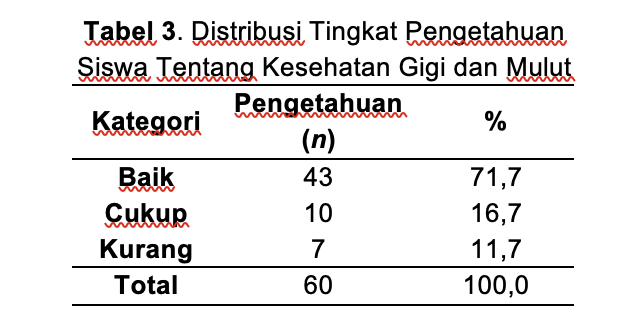
Background: Dental and oral health problems have a significant impact on both individuals and the overall healthcare system. According to the 2023 Indonesian Health Survey (SKI), half of the Indonesian population experiences dental and oral health issues, with decayed, missing, or filled teeth (DMF-T) problems reaching 43.6%. Elementary school-aged children are a vulnerable group for dental and oral health problems, influenced by poor hygiene attitudes and low knowledge levels. Knowledge is a process of knowing resulting from sensory perception, shaped by factors such as education, experience, media exposure, and environmental influences. Knowledge plays the most crucial role in determining individual actions and students' cognitive aspects. Objective: The purpose of this study was to determine the overview of dental and oral health knowledge among 5th and 6th-grade students at SD Inpres Mallengkeri Bertingkat Makassar. Methods: This research is a quantitative descriptive study conducted on February 2, 2026, with primary data collection using a validated questionnaire. Results: Based on the research results, it was found that the students' knowledge levels varied significantly, with the "poor" category at 11.7%, "fair" at 16.7%, and the "good" category dominating at 71.7%. Conclusion: It can be concluded that the students' knowledge level is generally in the good category, although variations in the fair and poor categories still exist. Special attention is needed through additional education for students in the fair and poor categories. This is necessary to prevent gaps in understanding regarding dental and oral health among 5th and 6th-grade students at SD Inpres Mallengkeri Bertingkat.