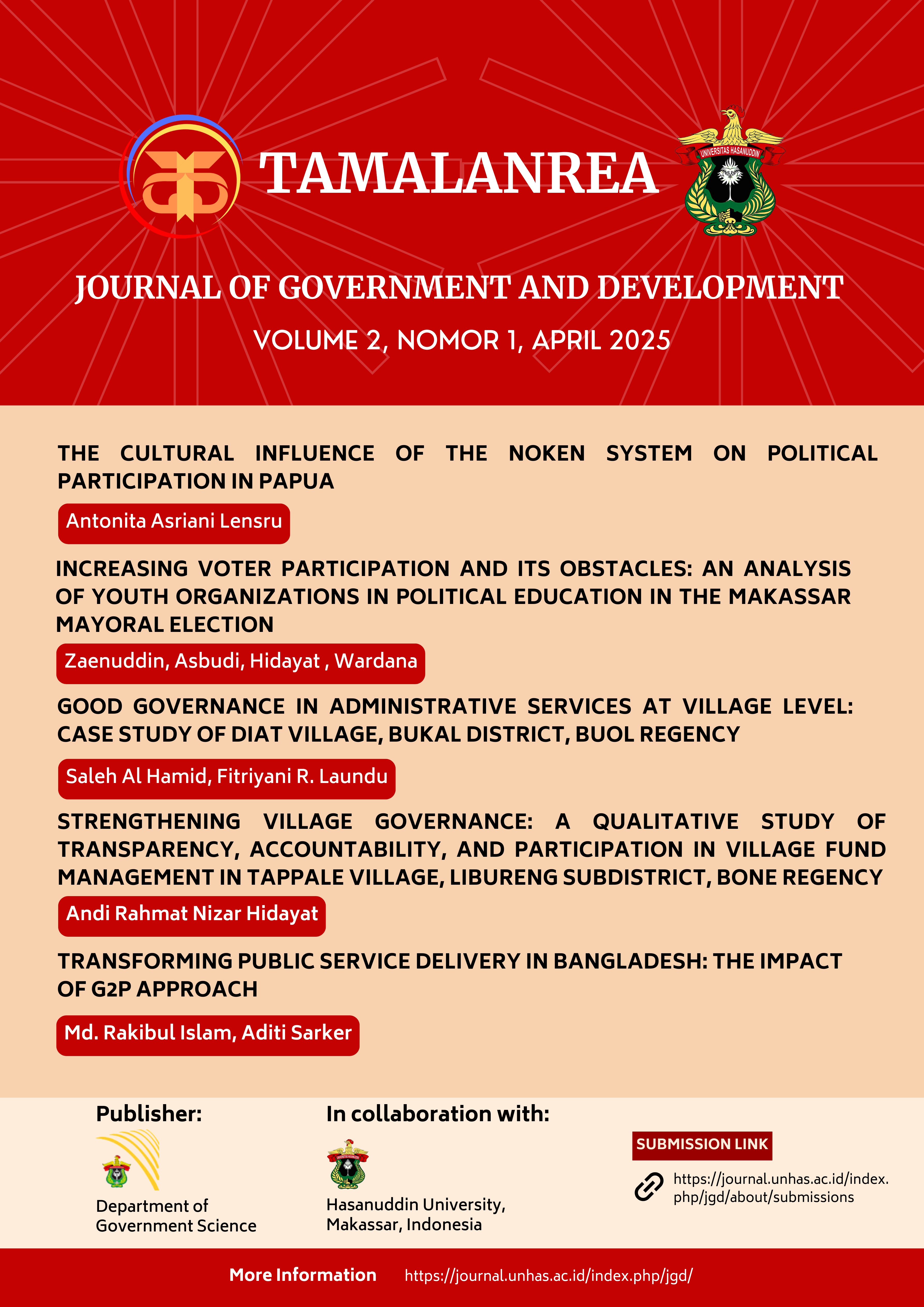
Transforming public service delivery in Bangladesh: The impact of G2P approach
DOI:
https://doi.org/10.69816/jgd.v2i1.43437Kata Kunci:
Government to Person (G2P), Mobile Finance Service (MFS), A2i (aspire to innovate), SSNP (social safety net program), PESP (primary education stipend project), National Identity (NID), Digital BangladeshAbstrak
In the digitized phase of Bangladesh, the government-to-person (G2P) approach represents an innovative shift in public service delivery. This model transforms the traditional "one to many" service approach into a "one to one" interaction, where the government directly engages with individual beneficiaries. This direct connection enhances transparency, accountability, and efficiency in service provision. The G2P approach is implemented across various projects in Bangladesh. This study aims to explore how G2P influences public service delivery perceptions and assess its impacts. A mixed-methods design was employed, and samples were selected from government officials and beneficiaries, totaling 120 participants. Data collection was accomplished through key informant interviews and surveys. The analysis utilized the Statistical Package for Social Science (SPSS) alongside detailed qualitative assessments. Discussions drawn from the analysis indicate notable impacts of G2P on public service delivery. Ultimately, it is suggested that the government and policymakers focus on expanding the scope of G2P services to ensure a structured, transparent, and efficient delivery of public services. While there are challenges to address, overcoming these barriers could facilitate a transformative phase in Bangladesh's governance system.
Unduhan
Diterbitkan
Terbitan
Bagian
Lisensi
Hak Cipta (c) 2025 Md. Rakibul Islam, Aditi Sarker

Artikel ini berlisensi Creative Commons Attribution-NonCommercial-NoDerivatives 4.0 International License.