
An annotated bird checklist for Gam island, Raja Ampat, including field notes on species monitoring and conservation
DOI:
https://doi.org/10.24259/fs.v4i2.8664Keywords:
Birds, Checklist, Conservation, Gam Island, New Guinea, Raja Ampat, Papua BaratAbstract
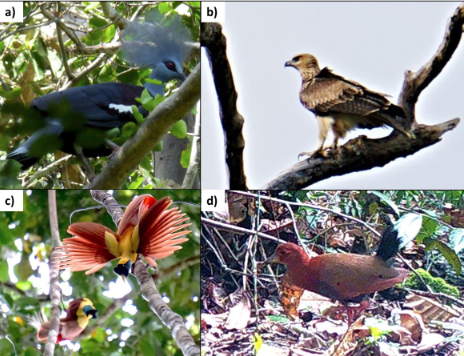
Species checklists are a fundamental component of biodiversity research. They foster understanding of species distributions and habitat preferences, thus reducing gaps of knowledge in geographical occurrences of species. Especially in light of the limited availability of data on species distributions for Tanah Papua, an increasing scientific focus on the region is crucial to foster and refine the knowledge of species occurrences and to inform potential conservation planning. Despite a strong focus on conservation of Raja Ampat´s marine areas, surprisingly few studies have focused on the terrestrial biodiversity of the archipelago. As a consequence, detailed species checklists are largely missing. Here, we provide a preliminary bird species checklist for the island of Gam and its surrounding islands, located in the central Raja Ampat archipelago. During nine sampling periods between 2013 and 2019, we recorded 132 bird species in six distinct habitat types. Of the detected species, six are considered threatened by IUCN Red List criteria. We further recorded three new species for Gam Island, thereby expanding their known extent of occurrence.
References
Allison, A. (2007). Introduction to the fauna of Papua. In: The Ecology of Papua Part One. The Ecology of Indonesia Series VI (ed. Marshall, A.J. and Beehler, B.M.). Periplus Editions, Singapore, pp. 479–494.
Beehler, B.M. (2007). Introduction to Papua. In: Ecology of Indonesian Papua Part One. The Ecology of Indonesia Series VI (eds. Marshall, A.J. & Beehler, B.M.). Periplus Editions, Singapore.
Beehler, B.M. & Pratt, T.K. (2016). Birds of New Guinea: distribution, taxonomy, and systematics. Princeton University Press
Cámara-Leret, R., Schuiteman, A., Utteridge, T., Bramley, G., Deverell, R., Fisher, L.A., McLeod, J., Hannah, L., Roehrdanz, P., Laman, T.G., Scholes, E., De Fretes, Y. & Heatubun, C. (2019a). The Manokwari Declaration: Challenges ahead in conserving 70% of Tanah Papua’s forests. Forest and Society, 3, 148–151. doi: http://dx.doi.org/10.24259/fs.v3i1.6067
Cámara-Leret, R., Raes, N., Roehrdanz, P., De Fretes, Y., Heatubun, C.D., Roeble, L., Schuiteman, A., van Welzen, P.C. & Hannah, L. (2019b). Climate change threatens New Guinea’s biocultural heritage. Science Advances, 5, eaaz1455. doi: http://dx.doi.org/10.1126/sciadv.aaz1455
Diamond, J.M. & Bishop, K. D. (2015). Avifaunas of the Kumawa and Fakfak Mountains, Indonesian New Guinea. Bulletin of the British Ornithologists’ Club, 135, 292–336.
Diamond, J.M. & Lecroy, M. (1979). Birds of Karkar and Bagabag islands, New Guinea. Bulletin American Museum of Natural History, 164, 467–531.
Diamond, J.M. (1972). Biogeographic kinetics: estimation of relaxation times for avifaunas of Southwest Pacific Islands. Proceedings of the National Academy of Sciences, 69, 3199–3203. doi: https://doi.org/10.1073/pnas.69.11.3199
Diamond, J.M. (1974). Colonization of exploded volcanic islands by birds: the supertramp strategy. Science, 184, 803–806. doi: https://doi.org/10.1126/science.184.4138.803
Djarwoto, A., Suhendar, R., Lastiadi, H.A. & others. (2013). Geodiversity Raja Ampat islands and tourism development. International Proceedings of Chemical, Biological and Environmental Engineering (IPCBEE), 52, 10–13.
Freeman, B.G. & Class Freeman, A.M. (2014). Rapid upslope shifts in New Guinean birds illustrate strong distributional responses of tropical montane species to global warming. Proceedings of the National Academy of Sciences of the United States of America, 111, 4490–4494. doi: https://doi.org/10.1073/pnas.1318190111
Gregory, P. (2017). Birds of New Guinea Including Bismarck Archipelago and Bougainville. Lynx Editions. Barcelona.
Heads, M. (2002). Birds of paradise, biogeography and ecology in New Guinea: A review. Journal of Biogeography, 28, 893–925. doi: https://doi.org/10.1046/j.1365-2699.2001.00600.x
IUCN. (2019). The IUCN Red List of Threatened Species [WWW Document]. Version 2019-2.
Johnstone, R.E. (2006). The birds of Gag Island, Western Papuan Islands, Indonesia. Records of the Western Australian Museum, 23, 115–132. doi: https://doi.org/10.18195/issn.0312-3162.23(2).2006.115-132
Kreft, H. & Jetz, W. (2010). A framework for delineating biogeographical regions based on species distributions. Journal of Biogeography, 37, 2029–2053. doi: https://doi.org/10.1111/j.1365-2699.2010.02375.x
Mack, A. & Dumbacher, J. (2007). Birds of Papua. In: The Ecology of Papua Part One. The Ecology of Indonesia Series VI (ed. Marshall, A.J. and Beehler, B.M.). Periplus Editions, Singapore, pp. 654–688.
Marshall, A.J. & Beehler, B.M. (2007). Ecology of Indonesian Papua Part Two. The Ecology of Indonesia Series VI. Periplus Editions, Singapore.
McLeod, E., Szuster, B. & Salm, R. (2009). Sasi and Marine Conservation in Raja Ampat, Indonesia. Coastal Management, 37, 656–676. doi: https://doi.org/10.1080/08920750903244143
Meyer, C., Kreft, H., Guralnick, R. & Jetz, W. (2015). Global priorities for an effective information basis of biodiversity distributions. Nature Communications, 6, 8221. doi: https://doi.org/10.1038/ncomms9221
Mittermeier, R.A., Mittermeier, C.G., Brooks, T.M., Pilgrim, J.D., Konstant, W.R., da Fonseca, G.A.B. & Kormos, C. (2003). Wilderness and biodiversity conservation. Proceedings of the National Academy of Sciences, 100, 10309. doi: https://doi.org/10.1073/pnas.1732458100
Noske, R.A., Green, B.S., Phillips, R., Laman, T.G. & Wonggor, Z. (2016). First nest and juvenile plumage descriptions of the ashy robin Heteromyias albispecularis of vogelkop Peninsula, West Papua. Kukila, 19, 53–59.
Orme, C.D.L., Davies, R.G., Burgess, M., Eigenbrod, F., Pickup, N., Olson, V.A., Webster, A.J., Ding, T.-S., Rasmussen, P.C., Ridgely, R.S., Stattersfield, A.J., Bennett, P.M., Blackburn, T.M., Gaston, K.J. & Owens, I.P.F. (2005). Global hotspots of species richness are not congruent with endemism or threat. Nature, 436, 1016–1019. doi: https://doi.org/10.1038/nature03850
Pratt, T.K. & Beehler, B.M. (2015). Birds of New Guinea. 2nd edition. Princeton University Press.
Roberts, C.M., McClean, C.J., Veron, J.E.N., Hawkins, J.P., Allen, G.R., McAllister, D.E., Mittermeier, C.G., Schueler, F.W., Spalding, M., Wells, F., Vynne, C. & Werner, T.B. (2002). Marine biodiversity hotspots and conservation priorities for tropical reefs. Science, 295, 1280–1284. doi: https://doi.org/10.1126/science.1067728
Schrader, J., Moeljono, S., Keppel, G. & Kreft, H. (2019a). Plants on small islands revisited: the effects of spatial scale and habitat quality on the species-area relationship. Ecography, 42, 1405–1414. doi: https://doi.org/10.1111/ecog.04512
Schrader, J., König, C., Moeljono, S., Pärtel, M. & Kreft, H. (2019b). Requirements of plant species are linked to area and determine species pool and richness on small islands. Journal of Vegetation Science, 30, 599–609. doi: https://doi.org/10.1111/jvs.12758
Takeuchi, W. (2002). An ecological summary of the Raja Ampat vegetation. In: Report on a rapid ecological assessment of the Raja Ampat Islands, Papua, Eastern Indonesia, held October 30 – November 22, 2002. pp. 97–108.
Takeuchi, W. (2003). A community-level floristic reconnaissance of the Raja Ampat islands in New Guinea. SIDA, 20, 1093–1138.
Wallace, A.R. (1869). The Malay Archipelago. London.
Weatherall, P., K. M. Marks, M. Jakobsson, T. Schmitt, S. Tani, J. E. Arndt, M. Rovere, et al. 2015. A new digital bathymetric model of the world’s oceans. Earth and Space Science 2:331–345. doi: https://doi.org/10.1002/2015EA000107
Additional Files
Published
Versions
- 2020-08-17 (2)
- 2020-08-17 (1)
Issue
Section
Categories
License
Copyright (c) 2020 Forest and Society

This work is licensed under a Creative Commons Attribution 4.0 International License.
This is an open access journal which means that all contents is freely available without charge to the user or his/her institution. Users are allowed to read, download, copy, distribute, print, search, or link to the full texts of the articles in this journal without asking prior permission from the publisher or the author. This is in accordance with the BOAI definition of open access.
Submission of an article implies that the work described has not been published previously (except in the form of an abstract or as part of a published lecture or academic thesis), that it is not under consideration for publication elsewhere, that its publication is approved by all authors and tacitly or explicitly by the responsible authorities where the work was carried out, and that, if accepted, will not be published elsewhere in the same form, in English or in any other language, without the written consent of the Publisher. An article based on a section from a completed graduate dissertation may be published in Forest and Society, but only if this is allowed by author's(s') university rules. The Editors reserve the right to edit or otherwise alter all contributions, but authors will receive proofs for approval before publication.
Forest and Society operates a CC-BY 4.0 © license for journal papers. Copyright remains with the author, but Forest and Society is licensed to publish the paper, and the author agrees to make the article available with the CC-BY 4.0 license. Reproduction as another journal article in whole or in part would be plagiarism. Forest and Society reserves all rights except those granted in this copyright notice