
Actors, Access, Markets, and Values Involved in Oil Palm Expansion and Peatland Degradation in West Kalimantan, Indonesia
DOI:
https://doi.org/10.24259/fs.v9i1.34533Keywords:
Oil palm, Peatlands, Political ecology, Regulatory incongruence, Access mechanisms, SustainabilityAbstract
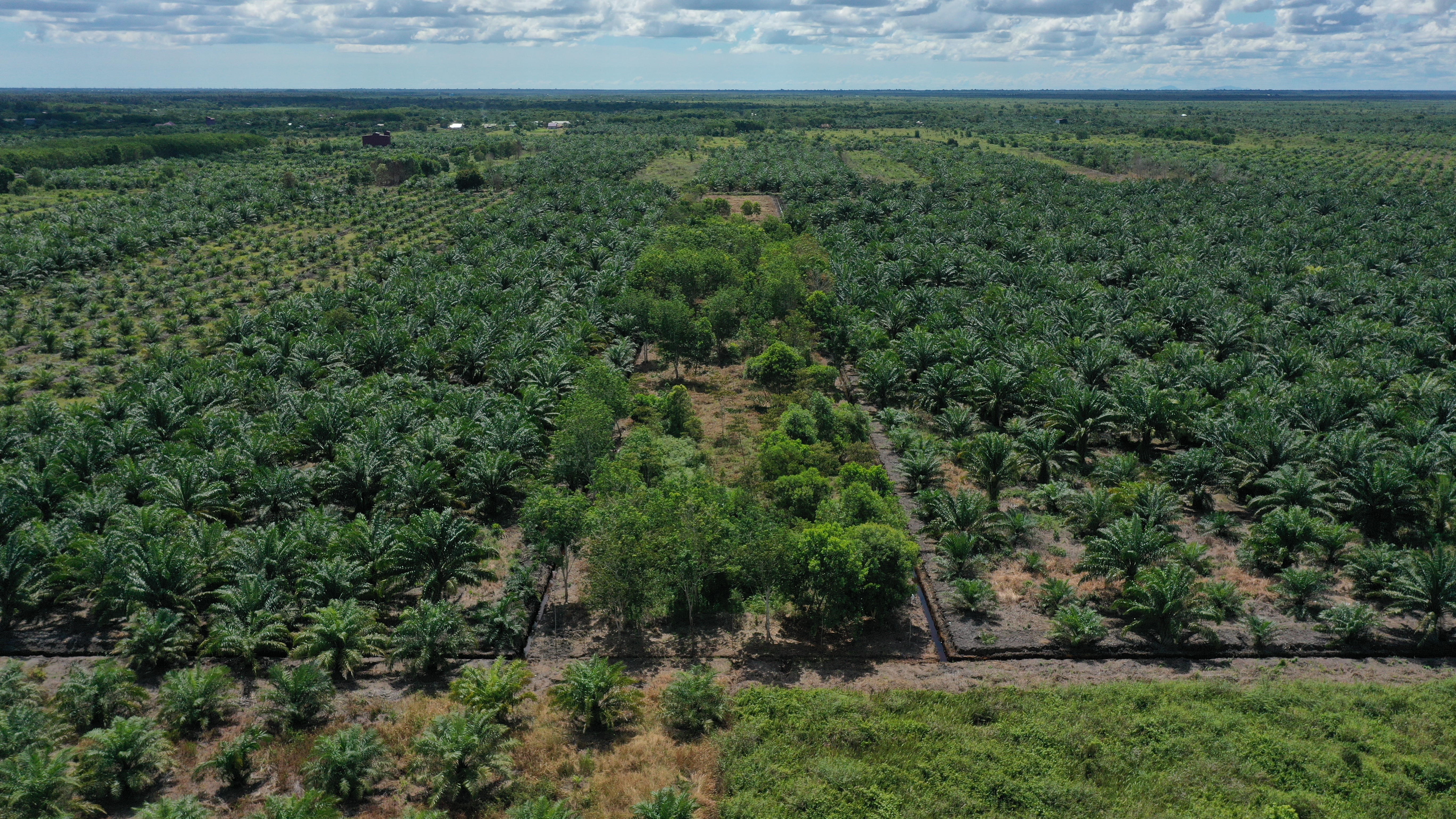
Despite numerous government regulations aimed at protecting Indonesia’s peatlands and surrounding communities, the rapid conversion of peatlands to oil palm plantations, coupled with associated fires, continues to cause severe environmental degradation and health-threatening haze that extends to neighboring countries. This study examines the political ecology of oil palm expansion and peatland degradation in the Pelang Peat Landscape, Ketapang, West Kalimantan, focusing on the period 2000–2021. By integrating spatial analysis with qualitative methods—including active participation, in-depth interviews, group discussions, and document review—this research uncovers the dynamics of land-use change and access mechanisms. Findings reveal that oil palm expansion has resulted in significant ecological degradation, particularly in Peat Ecosystem Protection (FLEG) zones, driven by hybrid access mechanisms that combine regulation-based (legal and illegal) and structural-relational strategies, such as financial capital, political authority, identity, and informal land markets. The study also identifies "astroturfing oil palm plantations" as a strategy by large corporations posing as cooperatives to bypass regulations, exacerbating degradation. Expansion patterns are categorized into three forms—centered, spotted, and dispersed—each shaped by actor motivations and capacities. Furthermore, the analysis highlights the interplay between instrumental values (profit-driven motives) and relational values (sustainability and community well-being), which underscores broader tensions in peatland governance. Regulatory incongruence further complicates enforcement, allowing actors to exploit legal ambiguities, perpetuating the "legal, but illegal" and "illegal, but legal" phenomena. These findings underscore the urgent need for integrated governance approaches that address ecological, social, and policy challenges in peatland management.
References
Abdurrahim, A. Y., Farida, F., van Noordwijk, M., Yogaswara, H., Adiwibowo, S., Dharmawan, A. H., & Sari, R. R. (2021). Collective action in lake management (CALM): An Indonesian stocktake. IOP Conference Series: Earth and Environmental Science, 789, 012039. https://doi.org/10.1088/1755-1315/789/1/012039
Abdurrahim, A. Y., Adhuri, D. S., Ross, H., & Phelan, A. (2022). Community champions of ecosystem services: The role of local agency in protecting Indonesian coral reefs. Frontiers in Ecology and Evolution. https://doi.org/10.3389/fevo.2022.868218
Abdurrahim, A. Y., Dharmawan, A. H., Adiwibowo, S., Yogaswara, H., & van Noordwijk, M. (2023). Relational and instrumental values of tropical peat landscapes: Morality and political ecology in Indonesia. Current Opinion in Environmental Sustainability, 64, 101318. https://doi.org/10.1016/j.cosust.2023.101318
Astuti, R. (2020). Fixing flammable forest: The scalar politics of peatland governance and restoration in Indonesia. Asia Pacific Viewpoint, 61. https://doi.org/10.1111/apv.12267
Astuti, R. (2021). Governing the ungovernable: The politics of disciplining pulpwood and palm oil plantations in Indonesia’s tropical peatland. Geoforum, 124, 381–391. https://doi.org/10.1016/j.geoforum.2021.03.004
Bernstein, H. (2010). Class dynamics of agrarian change (Vol. 1). Kumarian Press.
Bernstein, H. (2017). Food sovereignty via the ‘peasant way’: a sceptical view. In Critical perspectives on food sovereignty (pp. 131-164). Routledge.
Blaikie, P. (1985). The political economy of soil erosion in developing countries. Routledge.
Blaikie, P., & Brookfield, H. (1987). Land degradation and society. Routledge.
Blaikie, P. (1995). Changing environments or changing views? A political ecology for developing countries. Geography, 80(3), 203–214. https://doi.org/10.1080/20436564.1995.12452497
Blaikie, P. (2008). Epilogue: Towards a future for political ecology that works. Geoforum, 39(2), 765–772. https://doi.org/10.1016/j.geoforum.2007.07.004
Bryant, R. L., & Bailey, S. (1997). Third world political ecology. Psychology Press.
Carmenta, R., Zabala, A., Daeli, W., & Phelps, J. (2017). Perceptions across scales of governance and the Indonesian peatland fires. Global Environmental Change, 46, 50–59. https://doi.org/10.1016/j.gloenvcha.2017.08.001
Dhandapani, S., Ritz, K., Evers, S., & Sjögersten, S. (2019). Environmental impacts as affected by different oil palm cropping systems in tropical peatlands. Agriculture, Ecosystems & Environment, 276, 8–20. https://doi.org/10.1016/j.agee.2019.02.012
Dhandapani, S., & Evers, S. (2020). Oil palm “slash-and-burn” practice increases post-fire greenhouse gas emissions and nutrient concentrations in burnt regions of an agricultural tropical peatland. Science of The Total Environment, 742, 140648. https://doi.org/10.1016/j.scitotenv.2020.140648
Dharmawan, A. H., Mardiyaningsih, D. I., Komarudin, H., Ghazoul, J., Pacheco, P., & Rahmadian, F. (2020). Dynamics of rural economy: A socio-economic understanding of oil palm expansion and landscape changes in East Kalimantan, Indonesia. Land, 9(7), 213. https://doi.org/10.3390/land9070213
Dohong, A., Aziz, A., & Dargusch, P. (2017). A review of the drivers of tropical peatland degradation in South-East Asia. Land Use Policy, 69, 349–360. https://doi.org/10.1016/j.landusepol.2017.09.035
Fiske, A. P. (1992). The four elementary forms of sociality: Framework for a unified theory of social relations. Psychological Review, 99(4), 689–723. https://psycnet.apa.org/doi/10.1037/0033-295X.99.4.689
Forsyth, T. (2008). Political ecology and the epistemology of social justice. Geoforum, 39(2), 756–764. https://doi.org/10.1016/j.geoforum.2006.12.005
Gaveau, D. L. A., Sheil, D., Husnayaen, Salim, M. A., Arjasakusuma, S., Ancrenaz, M., Pacheco, P., & Meijaard, E. (2016). Rapid conversions and avoided deforestation: Examining four decades of industrial plantation expansion in Borneo. Scientific Reports, 6, 32017. https://doi.org/10.1038/srep32017
Gaveau, D. L., Locatelli, B., Salim, M. A., Yaen, H., Pacheco, P., & Sheil, D. (2019). Rise and fall of forest loss and industrial plantations in Borneo (2000–2017). Conservation Letters, 12(3), e12622. https://doi.org/10.1111/conl.12622
Gaveau, D. L., Locatelli, B., Salim, M. A., Husnayaen, Manurung, T., Descals, A., ... & Sheil, D. (2022). Slowing deforestation in Indonesia follows declining oil palm expansion and lower oil prices. PloS one, 17(3), e0266178. https://doi.org/10.1371/journal.pone.0266178
Girkin, N., Cooper, H., Ledger, M., O’Reilly, P., Thornton, S., Åkesson, A., Cole, L., Hapsari, K. A., Hawthorne, D., & Roucoux, K. (2022). Tropical peatlands in the Anthropocene: The present and the future. Anthropocene, 40, 100354. https://doi.org/10.1016/j.ancene.2022.100354
Githinji, M., van Noordwijk, M., Muthuri, C., Speelman, E. N., & Hofstede, G. J. (2023). Farmer land-use decision-making from an instrumental and relational perspective. Current Opinion in Envir onmental Sustainability, 63, 101303. https://doi.org/10.1016/j.cosust.2023.101303
Government of Indonesia. (2014). Government Regulation No. 71 of 2014 on Protection and Management of Peat Ecosystems [Government Regulation]. https://peraturan.bpk.go.id/Details/5513/pp-no-71-tahun-2014
Government of Indonesia. (2016). Government Regulation No. 57 of 2016 amending Government Regulation No. 71 of 2014 on Protection and Management of Peat Ecosystems [Government Regulation]. https://peraturan.bpk.go.id/Details/5778/pp-no-57-tahun-2016
Haidt, J., & Kesebir, S. (2010). Morality. In S. T. Fiske, D. T. Gilbert, & G. Lindzey (Eds.), Handbook of social psychology (Vol. 2, 5th ed., pp. 797–832). John Wiley & Sons, Inc.
Hall, D. (2011). Land grabs, land control, and Southeast Asian crop booms. The Journal of Peasant Studies, 38(4), 837–857. https://doi.org/10.1080/03066150.2011.607706
Hall, D., Li, T. M., & Hirsch, P. (2011). Powers of exclusion: Land dilemmas in Southeast Asia. NUS Press. https://nuspress.nus.edu.sg/products/powers-of-exclusion
Kemper, T. (2016). Elementary forms of social relations: Status, power and reference groups. Routledge.
Ketapang Regency Government. (2023). Masterplan Pencegahan Kebakaran Hutan dan Lahan Berbasis Tata Kelola Gambut di Kesatuan Hidrologis Gambut (KHG) Sungai Pawan–Sungai Kepulu dan Sungai Kepulu–Sungai Pesaguan Kabupaten Ketapang, Provinsi Kalimantan Barat. Ketapang Regency Government.
Langston, J. D., Mendham, D. S., & Sakuntaladewi, N. (2023). Dreaming of wetscapes: Waking to the realities of restoration. Ambio, 53(2), 351–362. https://doi.org/10.1007/s13280-023-01956-8
Leimona, B., van Noordwijk, M., Mithöfer, D., & Cerutti, P. (2017). Environmentally and socially responsible global production and trade of timber and tree crop commodities: Certification as a transient issue-attention cycle response to ecological and social issues. International Journal of Biodiversity Science, Ecosystem Services & Management, 13(1), 497–502. https://doi.org/10.1080/21513732.2018.1469596
Leimona, B., Mithöfer, D., Wibawa, G., & van Noordwijk, M. (2024). Sustainability certification: Multiple values of nature coexist in value chain transformations toward a common but differentiated responsibility. Current Opinion in Environmental Sustainability, 66, 101393. https://doi.org/10.1016/j.cosust.2023.101393
Lusiana, B., Slingerland, M., Miccolis, A., Khasanah, N., Leimona, B., & van Noordwijk, M. (2023). Oil palm production, instrumental and relational values: The public relations battle for hearts, heads, and hands along the value chain. Current Opinion in Environmental Sustainability, 64, 101321. https://doi.org/10.1016/j.cosust.2023.101321
Miettinen, J., & Liew, S. C. (2003). Connection between fire and land cover change in Riau Province, Sumatra from 1998 to 2002. In IGARSS 2003. 2003 IEEE International Geoscience and Remote Sensing Symposium. Proceedings (Vol. 4) (pp. 2496–2498). IEEE. https://ieeexplore.ieee.org/document/1294487
Miettinen, J., & Liew, S. C. (2010). Status of peatland degradation and development in Sumatra and Kalimantan. Ambio, 39(5–6), 394–401. https://doi.org/10.1007/s13280-010-0051-2
Miettinen, J., Shi, C., & Liew, S. C. (2016). Land cover distribution in the peatlands of Peninsular Malaysia, Sumatra and Borneo in 2015 with changes since 1990. Global Ecology and Conservation, 6, 67–78. https://doi.org/10.1016/j.gecco.2016.02.004
Ministry of Environment and Forestry (MoEF). (2018). PPKL-MoEF Decree No. 40 of 2018 concerning Determination of Peat Ecosystem Damage Status. http://pkgppkl.menlhk.go.id/v0/keputusan-dirjen-ppkl-nomor-sk-40-tahun-2018-penetapan-status-kerusakan-ekosistem-gambut/
Ministry of Environment and Forestry (MoEF). (2021). Corrective action on peatland protection and management in Indonesia: Toward sustainable peatland management 2019–2020. http://pkgppkl.menlhk.go.id/v0/en/corrective-action-on-peatland-protection-and-management-in-indonesia-2019-2020/
Nusantara Atlas. (2024). Location and evidence-based stories linking deforestation and fire alerts. https://map.nusantara-atlas.org
Omar, M. S., Ifandi, E., Sukri, R. S., Kalaitzidis, S., Christanis, K., Lai, D. T. C., Bashir, S., & Tsikouras, B. (2022). Peatlands in Southeast Asia: A comprehensive geological review. Earth-Science Reviews, 232, 104149. https://doi.org/10.1016/j.earscirev.2022.104149
Page, S. E., & Hooijer, A. (2016). In the line of fire: The peatlands of Southeast Asia. Philosophical Transactions of the Royal Society B: Biological Sciences, 371(1696), 20150176. https://doi.org/10.1098/rstb.2015.0176
Peluso, N. L., & Ribot, J. (2020). Postscript: A theory of access revisited. Society & Natural Resources, 33(2), 300–306. https://doi.org/10.1080/08941920.2019.1709929
Perreault, T. A., Bridge, G., & McCarthy, J. (Eds.). (2015). The Routledge handbook of political ecology (p. 646). London: Routledge.
Peatland and Mangrove Restoration Agency (PMRA). (2021). Rencana Tindakan Tahunan Restorasi Ekosistem Gambut di Kalimantan Barat 2021 –2024.
Pouliot, V. (2016). International pecking orders: The politics and practice of multilateral diplomacy. Cambridge University Press.
Ramdani, R., & Lounela, A. (2020). Palm oil expansion in tropical peatland: Distrust between advocacy and service environmental NGOs. Forest Policy and Economics, 118, 102242. https://doi.org/10.1016/j.forpol.2020.102242
Reed, J., Kusters, K., Barlow, J., Bessike Balinga, M. P., Borah, J., Carmenta, R., Chervier, C., Houria, D., Gumbo, D., Laumonier, Y., et al. (2021). Re-integrating ecology into integrated landscape approaches. Landscape Ecology, 36, 2935–2948. https://doi.org/10.1007/s10980-021-01268-w
Ribot, J., & Peluso, N. (2003). A theory of access. Rural Sociology, 68(2), 153–181. https://doi.org/10.1111/j.1549-0831.2003.tb00133.x
Robbins, P. (2019). Political ecology: A critical introduction (3rd ed.). John Wiley & Sons.
Rocheleau, D. E. (2008). Political ecology in the key of policy: From chains of explanation to webs of relation. Geoforum, 39(2), 716–727. https://doi.org/10.1016/j.geoforum.2007.02.005
Roh, Y., Kim, S., Han, S. H., Lee, J., & Son, Y. (2018). Rewetting strategies for the drained tropical peatlands in Indonesia. Korean Journal of Environmental Biology, 36(1), 33–42. https://doi.org/10.11626/KJEB.2018.36.1.033
Saputra, E. (2019). Beyond fires and deforestation: Tackling land subsidence in peatland areas, a case study from Riau, Indonesia. Land, 8(5), 76. https://doi.org/10.3390/land8050076
Sayer, J., Sunderland, T., Ghazoul, J., Pfund, J.-L., Sheil, D., Meijaard, E., Venter, M., Boedhihartono, A., Day, M., Garcia, C., et al. (2013). Ten principles for a landscape approach to reconciling agriculture, conservation, and other competing land uses. Proceedings of the National Academy of Sciences, 110(21), 8345–8348. https://doi.org/10.1073/pnas.1210595110
Schlager, E., & Ostrom, E. (1992). Property-rights regimes and natural resources: A conceptual analysis. Land Economics, 68(3), 249–262. https://doi.org/10.2307/3146375
Scoones, I. (2009). Livelihoods perspectives and rural development. Journal of Peasant Studies, 36(1), 171–196. https://doi.org/10.1080/03066150902820503
Scoones, I. (2015). Sustainable livelihoods and rural development. https://opendocs.ids.ac.uk/articles/monograph/Sustainable_Livelihoods_And_Rural_Development/26484079/1
Scoones, I., Leach, M., & Newell, P. (2015). The politics of green transformations. Routledge. https://doi.org/10.4324/9781315747378
Scoones, I. (2016). The politics of sustainability and development. Annual Review of Environment and Resources, 41(1), 293–319. https://doi.org/10.1146/annurev-environ-110615-090039
Scoones, I., & Stirling, A. (2020). Uncertainty and the politics of transformation. In The politics of uncertainty: Challenges of transformation (pp. 1–30). Routledge. https://www.taylorfrancis.com/chapters/oa-edit/10.4324/9781003023845-1/uncertainty-politics-transformation-ian-scoones-andy-stirling
Svarstad, H., & Benjaminsen, T. A. (2024). Political ecology and the power of sociology. In Elgar encyclopedia of environmental sociology (pp. 447–453). Edward Elgar Publishing. https://doi.org/10.4337/9781803921044.ch79
Temmink, R. J. M., Robroek, B. J. M., van Dijk, G., Koks, A. H. W., Käärmelahti, S. A., Barthelmes, A., Wassen, M. J., Ziegler, R., Steele, M. N., Giesen, W., et al. (2023). Wetscapes: Restoring and maintaining peatland landscapes for sustainable futures. Ambio, 52(9), 1519–1528. https://doi.org/10.1007/s13280-023-01875-8
Uda, S., Schouten, G., & Hein, L. (2018). The institutional fit of peatland governance in Indonesia. Land Use Policy, 99, 103006. https://doi.org/10.1016/j.landusepol.2018.03.031
van Noordwijk, M., Speelman, E., Hofstede, G. J., Farida, A., Abdurrahim, A. Y., Miccolis, A., Hakim, A. L., Wamucii, C. N., Lagneaux, E., & Andreotti, F., et al. (2020). Sustainable agroforestry landscape management: Changing the game. Land, 9(8), 243. https://doi.org/10.3390/land9080243
van Noordwijk, M., Leimona, B., Amaruzaman, S., Pascual, U., Minang, P. A., & Prabhu, R. (2023). Five levels of internalizing environmental externalities: Decision-making based on instrumental and relational values of nature. Current Opinion in Environmental Sustainability, 63, 101299. https://doi.org/10.1016/j.cosust.2023.101299
Waeber, P., Carmenta, R., Estrada-Carmona, N., Garcia, C., Falk, T., Fellay, A., Ghazoul, J., Reed, J., Willemen, L., Zhang, W., et al. (2023). Structuring the complexity of integrated landscape approaches into selectable, scalable, and measurable attributes. Environmental Science & Policy, 147, 67–77. https://doi.org/10.1016/j.envsci.2023.06.003
Additional Files
Published
Issue
Section
Categories
License
Copyright (c) 2025 Forest and Society

This work is licensed under a Creative Commons Attribution 4.0 International License.
This is an open access journal which means that all contents is freely available without charge to the user or his/her institution. Users are allowed to read, download, copy, distribute, print, search, or link to the full texts of the articles in this journal without asking prior permission from the publisher or the author. This is in accordance with the BOAI definition of open access.
Submission of an article implies that the work described has not been published previously (except in the form of an abstract or as part of a published lecture or academic thesis), that it is not under consideration for publication elsewhere, that its publication is approved by all authors and tacitly or explicitly by the responsible authorities where the work was carried out, and that, if accepted, will not be published elsewhere in the same form, in English or in any other language, without the written consent of the Publisher. An article based on a section from a completed graduate dissertation may be published in Forest and Society, but only if this is allowed by author's(s') university rules. The Editors reserve the right to edit or otherwise alter all contributions, but authors will receive proofs for approval before publication.
Forest and Society operates a CC-BY 4.0 © license for journal papers. Copyright remains with the author, but Forest and Society is licensed to publish the paper, and the author agrees to make the article available with the CC-BY 4.0 license. Reproduction as another journal article in whole or in part would be plagiarism. Forest and Society reserves all rights except those granted in this copyright notice