
A Value Chain Approach to Forest Landscape Restoration: Insights from Vietnam’s Production-Driven Forest Restoration
DOI:
https://doi.org/10.24259/fs.v6i1.18038Keywords:
forest landscape restoration, production-driven, vicious and benign value chains, tree plantations, acacia, smallholder inclusion, certification, landscape mosaic, VietnamAbstract
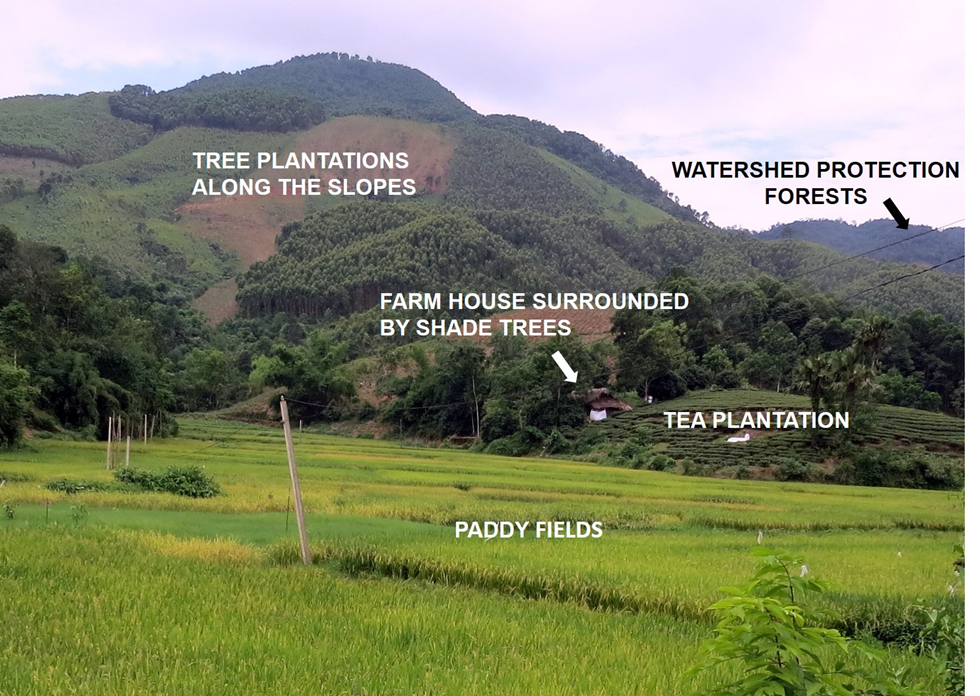
According to FAO figures, over 129 million hectares of forests have been lost globally since the 1990s, mainly in the tropical Global South, where agriculture acts as the main driver of forest conversion. International commitments, such as the Bonn Challenge, aim to reverse this trend through the application of forest landscape restoration (FLR) as an integrated and inclusive restoration approach. Beyond the discourse level, however, FLR implementation lags behind expectations due to insufficient funding and a disconnection with local implementation. We argue that, instead of relying on public resources for conservation-driven restoration, increased private sector engagement may point the way out of the funding impasse. However, this requires a shift towards production-driven FLR, which includes the livelihood needs of communities and smallholders as agents of landscape transition. For achieving the dual purpose of connecting landscapes with markets and promoting sustainable landscape restoration, we ascribe value chains and their economic, social and ecological configurations a key role in production-driven FLR. Drawing on Vietnam’s forest restoration pathway as an illustrative case, we examine how production-driven forest restoration, smallholder engagement and value chain upgrading can stimulate positive landscape transitions. We conclude that, depending on their configuration, value chains can have negative or positive social and ecological impacts at the landscape level. Furthermore, regulated, progressive and high-value commodity chains may perform better in the areas of integrated FLR objectives landscape integrity, ecological functionality and human well-being.
References
Agrawal, A., Cashore, B., Hardin, R., Shepherd, G., Benson, C. and Miller, D. (2013). Economic Contributions of Forests. Background paper prepared for the tenth session of the United Nations Forum on Forests held in Istanbul, 8-19 April 2013.
Arts, B., Buizer M., Horling L., Ingram V., van Oosten C. and Opdam, P. (2017). Landscape approaches: A state-of-the-art review. Annual Review of Environment and Resource 42, 439-463. https://doi.org/10.1146/annurev-environ-102016-060932
Auer, M. R. (2012). Group forest certification for smallholders in Vietnam: An early test and future prospects. Human Ecology, 40(1), 5-14. https://doi.org/10.1007/s10745-011-9451-6
Bolwig, S., Ponte S., du Toit, A., Riisgaard, L. and Halberg, N. (2010). Integrating poverty and environmental concerns into value-chain analysis: A conceptual framework. Development Policy Review, 28(2), 173-194. https://doi.org/10.1111/j.1467-7679.2010.00480.x
Bonn Challenge. (2019). Forest Landscape Restoration, 6 May 2019. Available at: http://www.bonnchallenge.org/content/forest-landscape-restoration
Brancalion, P. H. S. and Chazdon R. L. (2017). Beyond hectares: four principles to guide reforestation in the context of tropical forest and landscape restoration. Restoration Ecology, 25(4), 491-496. https://doi.org/10.1111/rec.12519
Burivalova, Z., Hua, F., Koh, L. P., Garcia, C. and Putz, F. (2017). A critical comparison of conventional, certified, and community management of tropical forests for timber in terms of environmental, economic, and social Variables. Conservation Letter, 10(1), 4-14. https://doi.org/10.1111/conl.12244
Cashore, B., Gale, F., Meidinger, E., & Newsom, D. (2006). Forest certification in developing and transitioning countries: part of a sustainable future?. Environment: Science and Policy for Sustainable Development, 48(9), 6-25. https://doi.org/10.3200/ENVT.48.9.6-25
Cannell, M. G. R. (1999). Environmental impacts of forest monocultures, water use and acidification, wildlife conservation and carbon storage. New Forests, 17, 239-262. https://doi.org/10.1023/A:1006551018221
Coles, C. and Mitchell, J. (2011). Working together – Horizontal coordination as an upgrading strategy. In J. Mitchell and C. Coles (Eds.), Markets and Rural Poverty: Upgrading in Value Chains (pp. 143-62). Earthscan.
Deans, H., Ros-Tonen, M. A. F. and Derkyi, M. (2018). Advanced value vhain vollaboration in Ghana’s vocoa sector: An entry point for integrated landscape approaches? Environmental Management, 62(1), 143–156. https://doi.org/10.1007/s00267-017-0863-y
FAO (2015). The global forest resources assessment. FAO.
FAO and Global Mechanisms of the UNCCD. (2015). Sustainable financing for forest and landscape restoration – Opportunities, challenges and the way forward. FAO.
Flanagan, A. C., Midgley, S.J., Stevens, P.R. and McWhirter, L. (2019). Smallholder tree-farmers and forest certification in Southeast Asia: Productivity, risks and policies. Australian Forestry, 82(1), 18-28. https://doi.org/10.1080/00049158.2018.1560569
Forest Stewardship Council (FSC) (2015) FSC International Standard, FSC Principles and Criteria for Forest Stewardship, FSC- STD-01-001-V5-2EN.
Forest Stewardship Council (FSC). (2019). 8 May 2019. Retrieved from http://fsc.force.com/servlet/servlet.FileDownload?file=00Pf300000wGHiXEAW
Forest Stewardship Council (FSC). (2020). Thua Thien Hue Forest Owners Sustainable Development Association (TTH-FOSDA) certificate information. Retrieved from https://info.fsc.org/details.php?id=a023300000d4nr8AAA&type=certificate
Gambetta, F. C., Stoian, D., Campos, J. J., Cancino, J. M. and Pinelo, G. (2004). Forest certification in Guatemala. Yale School of Forestry and Envrionmental Studies. Yale School of Forestry & Environmental Studies
Gereffi, G. (1999). International trade and industrial upgrading in the apparel commodity chain. Journal of International Economics, 48(1), 37-70. https://doi.org/10.1016/S0022-1996(98)00075-0
GoV. 2016-1: Decision no. 38/2016/QĐ-TTg, Policies on Protection, Development and Infrastructure Investment for Forestry Companies. Retrieved from https://thuvienphapluat.vn/van-ban/tai-nguyen-moitruong/Quyet-dinh-38-2016-QD-TTg-bao-ve-phat-trien-rung-dau-tu-ho-tro-ket-cau-ha-tang-congty-nong-lam-nghiep-322052.aspx
GoV. 2018-1: PM Decision No. 1288/QĐ-TTg, Approval of the Sustainable Forest Management and Forest Certification program. Dated 1st October 2018. Retrieved from https://luatvietnam.vn/tai-nguyen/quyetdinh- 1288-qd-ttg-2018-duyet-de-an-quan-ly-rung-ben-vung-va-chung-chi-rung-167561-d1.html
Gritten D., Greijmans M., Jihadah L. and Triraganon, R. (2018). Community forestry and forest landscape restoration: attracting sustainable investments for restoring degraded land in Southeast Asia. RECOFTC.
Ha, N. T. (2018). Local state actors and institutions and forest certification in Vietnam [Master thesis]. The Australian National University. Available at: http://ndeg.apps01.yorku.ca/wp-content/uploads/2018/02/Nga-Thi-Ha-Mastersthesis.pdf
Helmsing, A. H. J. and Vellema, S. (2011). Governance, inclusion and embedding: Raising the issues. In Helmsing, A. H. J. and S. Vellema (eds.), Value Chains, Inclusion and Endogenous Development Contrasting Theories and Realities, (pp. 1-16). Routledge.
Hoang, H.T., Hoshino, S. and Hashimoto, S. (2015a). Forest stewardship council certificate for a group of planters in Vietnam: SWOT analysis and implications. Journal of Forest Research, 20(1), 35-42. https://doi.org/10.1007/s10310-014-0472-z
Hoang, H.T., Hoshino, S. and Hashimoto, S. (2015b). Costs Comparison between FSC and Non-FSC Acacia Plantations in Quang Tri Province, Vietnam. International Journal of Environmental Science and Development, 6(12), 947-951. http://dx.doi.org/10.7763/IJESD.2015.V6.727
Ingram, V. (2014). Win-wins in forest product value chains? How governance impacts the sustainability of livelihoods based on non-timber forest products from Cameroon. African Studies Collection 56. African Studies Centre.
Issara, P., Adcharaporn, P., Popradit A., Ishida, A. and Somkid, U. (2019). Protected area co-management and land use conflicts adjacent to Phu Kao – Phu Phan Kham National Park, Thailand. Journal of Sustainable Forestry, 38(5), 486-507. https://doi.org/10.1080/10549811.2019.1573689
John Lewis. (2020). Sustainable timber and paper policy. Retrieved from https://www.johnlewispartnership.co.uk/content/dam/cws/images/tempfolder/csr/johnlewis- timber-paper-policy-SRS015.pdf
Jong W. D, Do, D. S. and Trieu, V. H. (2006). Forest rehabilitation in Vietnam: histories, realities and future. CIFOR.
Kalonga, S. K., Kulindwa, K. A., & Mshale, B. I. (2015). Equity in distribution of proceeds from forest products from certified community-based forest management in Kilwa District, Tanzania. Small-Scale Forestry, 14(1), 73-89. https://doi.org/10.1007/s11842-014-9274-6
Kalonga, S. K., Midtgaard F., Klanderud, K. (2016). Forest certification as a policy option in conserving biodiversity: An empirical study of forest management in Tanzania. Forest Ecology and Management 361, 1-12. https://doi.org/10.1016/j.foreco.2015.10.034
Kaplinsky, R. and Morris, M. (2001). A Handbook for Value Chain Research. Paper prepared for the IDRC. Retrieved from https://www.researchgate.net/profile/Mike-Morris-11/publication/42791981_A_Handbook_for_Value_Chain_Research/links/00b7d5173be8d93cc7000000/A-Handbook-for-Value-Chain-Research.pdf
Kapp, G. and Manning, D. (2014). Land management systems at the interface between forestry and agriculture. In Pretzsch, J., Darr, D and H. Uibrig (Eds.), Forests and rural development (pp. 85-110). Springer
Kien, N.D., Thinh, H. H., Kha L.D., Nghia, N. H., Hai, P. H. and Hung, T. V. (2014). Acacia as a national resource of Vietnam. Acacia 2014: Sustaining the future of Acacia plantation forestry. International conference. IUFRO Working Party 2.08.07: Genetics and silviculture of Acacia. Hue, Vietnam. 18-21.03.2014, Compendium of Abstracts.
Kilelu, C., L. Klerkx, A. Omore, I. Baltenweck, C. Leeuwis and Githinji, J. (2017). Value Chain Upgrading the inclusion of smallholders in markets: Reflections on contributions of multi-stakeholder processes in diary development in Tanzania. The European Journal of Development Research, 29(5), 1102-1121. https://doi.org/10.1057/s41287-016-0074-z
Kissinger, G., Moroge, M., Noponen, M. (2015). Private sector investment in landscape approaches: the role of productions standards and certification. In Minang P, Van Noordwijk M, Freeman OE, Mbow C, De Leeuw J, and D. Cataculan (Eds.), Climate-smart landscapes: multifunctionality in practice (pp. 277-292). World Agroforestry Centre (ICRAF).
Kröger, M. (2012). The expansion of industrial tree plantations and dispossession in Brazil. Development and Change, 43(4), 947-973. https://doi.org/10.1111/j.1467-7660.2012.01787.x
Lamb, D., Erskine, D.P. and Parrotta, A. J. (2005). Restoration of degraded tropical forest landscape. Science, 310(5754), 1628-1632. https://doi.org/10.1126/science.1111773
Leijten, F., dos Reis, T.N.P., Sim, S., Verburg, P.H. and Meyfroidt, P. (2022). The influence of company sourcing patterns on the adoption and effectiveness of zero-deforestation commitments in Brazil’s soy supply chain. Environmental Science & Policy, 128, 208-215. https://doi.org/10.1016/j.envsci.2021.10.032
Liu, P. (2008). Certification in the value chain for fresh fruits. The example of banana industry. FAO Commodity Studies 4. FAO.
Loffler, H. J. M., Afiff, S., Burgers, P. P. M., Govers, C., Heeres, H. J., Karyanto, O., ... & Widyarani, R. (2014). Agriculture beyond food: experiences from Indonesia. NWO/WOTRO.
Lyons-White, J. and Knight, A.T. (2018). Palm oil supply chain complexity impedes implementation of corporate no-deforestation commitments. Global Environmental Change, 50, 303-313. https://doi.org/10.1016/j.gloenvcha.2018.04.012.
Maginnis, S. and Jackson, W. (2002). Restoring forest landscapes. IUCN.
Mansourian, S. (2016) Understanding the relationship between governance and forest landscape restoration. Conservation and Society, 14(3), 267-278. https://doi.org/10.4103/0972-4923.186830
Mansourian S. (2018). In the eye of the beholder: Reconciling interpretations of forest landscape restoration. Land Degradation and Development, 29, 2888–2898. https://doi.org/10.1002/ldr.3014
Maraseni, T. N., Hoang, L. S., Cockfield, G., Vu, H. D. and Tran, D. N. (2017). Comparing the financial returns from acacia plantation with different plantation densities and rotation ages in Vietnam. Forest Policy and Economics, 83, 80-87. https://doi.org/10.1016/j.forpol.2017.06.010
MARD. (2015). Forest Sector Development Report Year 2014. Forest Sector Support Program (FSSP) Annual Conference.
MARD. (2018). MARD decision no. 4691/QĐ-BNN-TCLN: Detailed implementation plan of the Sustainable Forest Management and Forest certification program. Dated 27th November 2018. Retrieved from http://thuvienphapluat.vn/van-ban/Tai-nguyen-Moi-truong/Quyet-dinh-4691-QD-BNNTCLN-2018-thuc-hien-De-an-Quan-ly-rung-ben-vung-va-chung-chi-rung-401019.aspx
MARD. (2019-1). Vietnam forestry status and statistic, 2018, dated 19th March 2019. Retrieved from http://tongcuclamnghiep.gov.vn/content/uploads/files/-2019.3.19%20No%20911.QĐ.BNN.TCL%DBR2018.pdf
McDermott, G. A. (2007). The politics of institutional renovation and economic upgrading. Recombining the vines that bind in Argentina. Politics and Society, 35(1), 103-144. https://doi.org/10.1177/0032329206297185
Midgley, S. J., Stevens, P. R. and Arnold, R. J. (2017). Hidden assets: Asia’s smallholder wood resources and their contribution to supply chains of commercial wood. Australian Forestry, 80(1), 10-25. https://doi.org/10.1080/00049158.2017.1280750
Molnar, A. (2004). Forest certification and communities, International Forestry Review 6(2), 173-180. https://doi.org/10.1505/ifor.6.2.173.38393
Moyo, F., Funk, S. and J. Pretzsch (2017). Between policy intent and practice: Negotiating access to land and other resources in Tanzania’s wildlife management areas. Tropical Conservation Science, 10, 1-17. https://doi.org/10.1177/1940082917744167
Muradian, R., Verschoor, G.M., Bolivar, E. and Ochoa, G. (2011). Building inclusive value chains in bio trade: a comparison of two cases from South America. In Helmsing A.H.J and S. Vellema (Eds.), Value chains, inclusion and endogenous development: Contrasting theories and realities (pp. 266-285). Routledge.
Nambiar, E. S., Harwood, C. E., & Kien, N. D. (2015). Acacia plantations in Vietnam: research and knowledge application to secure a sustainable future. Southern Forests: A Journal of Forest Science, 77(1), 1-10. https://doi.org/10.2989/20702620.2014.999301
Nambiar, E. S. (2019). Re-imagining forestry and wood business: Pathways to rural development, poverty alleviation and climate change mitigation in the tropics. Forest Ecology and Management, 448, 160-173. https://doi.org/10.1016/j.foreco.2019.06.014
Nutz, N. and Sievert, M. (2015). A rough guide to value chain development: A short guide for development practitioners, government and private sector initiatives. International Labour Office (ILO).
Overbeek, W., Kröger, M. and Gerber, J. F. (2012). An Overview over industrial tree plantations in the global South: Conflicts, trends and resistance struggles. EJOLT Report No. 3. International Institute of Social Studies of Erasmus University (ISS)
Owusu, R., Kimengsi, J. N., & Moyo, F. (2021). Community-based Forest Landscape Restoration (FLR): Determinants and policy implications in Tanzania. Land Use Policy, 109, 105664. https://doi.org/10.1016/j.landusepol.2021.105664
Pacheco, P., Gnych, S., Dermawan, A, Komarudin, H. and Okarda, B. (2017). The palm oil global value chain: Implications for economic growth and social and environmental sustainability. Working Paper 220. CIFOR.
PEFC (2018). PEFC group forest management: PEFC Benchmark Standard. Retrieved from http://www.pefc.com.uy/data/documentacion/PEFC_ST_1002-2018_- _Group_Forest_Management_Certification_2018-11-14.pdf
Perez-Aleman, P. and Sandilands, M. (2008). Building value at the top and the bottom of the global supply chain: MNC-NGO partnerships. California Management Review, 51(1), 24-48. https://doi.org/10.2307/41166467
Pham, T.T, Moeliono, M., Nguyen, T.H., Nguyen H.T. and Vu, T. H. (2012). The context of REDD+ in Vietnam: Drivers, agents and institutions. CIFOR. https://doi.org/10.17528/cifor/003737
Pirker, J., A. Mosnier, F. Kraxner, P. Havlík and Obersteiner, M. (2016). What are the limits to oil palm expansion? Global Environmental Change 40, 73-81. https://doi.org/10.1016/j.gloenvcha.2016.06.007
Pistorius, T., Hoang, H. D. T., Tennigkeit, T., Merger, E., Wittmann, M., & Conway, D. (2016). Business Models for the Restoration of short-rotation Acacia plantations in Vietnam. UNIQUE Forestry and Land Use GmbH. Retrieved from https://www.unique-landuse.de/images/publications/vereinheitlicht/Acacia-Business-Models-Vietnam.pdf
Pokorny, B. and De Jong, W. (2015). Smallholders and forest landscape transitions: locally devised development strategies of the tropical Americas. International Forestry Review, 17(1), 1-19. https://doi.org/10.1505/146554815814668981
Pye, O. and Bhattacharya, J. (Eds.) (2011). The Palm Oil Controversy in Southeast Asia–A Transnational Perspective. ISEAS.
Rasmussen, L.V., Watkins, C. and Agrawal, A. (2017). Forest contributions to livelihoods in changing agriculture-forest landscapes. Forest Policy and Economics, 84, 1-8. https://doi.org/10.1016/j.forpol.2017.04.010
Reinecke, S., & Blum, M. (2018). Discourses across scales on forest landscape restoration. Sustainability, 10(3), 613. https://doi.org/10.1016/j.forpol.2017.04.010
Ribot, J. (1998). Theorizing access: forest profits along Senegal’s charcoal commodity chain. Development and Change, 29(2), 307-341. https://doi.org/10.1111/1467-7660.00080
Rizzeti, D., Swaans K., Holden J., Brunner J., Le, T. and Nguyen, T. (2018). Assessing opportunities in forest landscape restoration in Quang Tri, Viet Nam. IUCN.
Ros-Tone, M.A.F., Leynseele, Y.V., Laven A. and Sunderland, T. (2015). Landscapes of social inclusion: Inclusive value-chain collaboration: Through the lenses of food sovereignty and landscape governance. European Journal of Development Research, 27, 523-540. https://doi.org/10.1057/ejdr.2015.50
Ros-Tonen, M. A., Reed, J., & Sunderland, T. (2018). From synergy to complexity: the trend toward integrated value chain and landscape governance. Environmental Management, 62(1), 1-14. https://doi.org/10.1007/s00267-018-1055-0
Sabogal, C., Besacier, C., & McGuire, D. (2015). Forest and landscape restoration: concepts, approaches and challenges for implementation. Unasylva, 66(245), 3-10.
Sandewall, M., Ohlsson, B., Sandewall, R. K., & Le Viet, S. (2010). The expansion of farm-based plantation forestry in Vietnam. Ambio, 39(8), 567-579. https://doi.org/10.1007/s13280-010-0089-1
Sawyer, J. (1993). Plantations in the tropics. Environmental concerns. IUCN.
Sayer, J., Sunderland, T., Ghazoul, J., Pfund, J. L., Sheil, D., Meijaard, E., ... & Buck, L. E. (2013). Ten principles for a landscape approach to reconciling agriculture, conservation, and other competing land uses. Proceedings of the National Academy of Sciences (PNAS), 110(21), 8349-8356. https://doi.org/10.1073/pnas.1210595110
Sayer, J., Ghazoul, J., Nelson, P. and Boedhihartono, A. K. (2012). Oil palm expansion transform tropical landscape and livelihoods. Global Food Security, 1(2), 114-119. https://doi.org/10.1016/j.gfs.2012.10.003
Sikor, T. (2012). Tree plantations, politics of possession and the absence of land grabs in Vietnam. Journal of Peasant Studies 39(3-4), 1077-1101. https://doi.org/10.1080/03066150.2012.674943
Sloth, C. and Le, C. U. (2009). Forest management pre-assessment report for: Linking trade demand for sustainable forest management project in Gio Linh and Vinh Linh Districts, Quang Tri Province. Unpublished document.
Snelder, D.J. and Lasco, R. D. (2008). Smallholder Tree Growing in South and Southeast Asia. In Snelder, D.J. and R. D. Laso (Eds.), Smallholder Tree Growing for Rural Development and Environmental Service: Lessons from Asia (pp. 3-33). Springer.
Darr, D., & Pretzsch, J. (2021). Analysis of Acacia hybrid timber value chains: A case study of woodchip and furniture production in central Vietnam. Forest Policy and Economics, 125, 102401. https://doi.org/10.1016/j.forpol.2021.102401
Tran, T. M. A., Ko, D. W., Park, C. R. and Le, H. D. (2018). A bayesian network analysis of reforestation decisions by rural mountain communities in Vietnam. Forest Science and Technology 15(2), 51-57. https://doi.org/10.1080/21580103.2019.1581665
Trienekens, J.H. (2012). Value Chains in Developing Countries. A Framework for Analysis. In Van Dijk, M.P. and J. Trienekens (Eds.), Global Value Chains. Linking Local Producers from Developing Countries to International Markets (pp. 43-68). Amsterdam University Press.
Trienekens, J.H. and van Dijk, M. P. (2012). Upgrading of Value Chains in Developing Countries. In Van Dijk, M.P. and J. Trienekens (Eds.), Global Value Chains. Linking Local Producers from Developing Countries to International Markets (237-250). Amsterdam University Press.
To, P.X., Nguyen, V.Q., Nguyen, T.Q. and Cao, T.C. (2017). Linkage between woodworking companies and forest plantation households: Upgrade value chain for wood industry. Forest Trend.
Van Dijk, M.P. and Trienekens, J. (2012) Global Value Chains. An Overview of the Issues and Concepts. In Van Dijk, M.P. and J. Trienekens (Eds.), Global Value Chains. Linking Local Producers from Developing Countries to International Markets (pp. 9-30). Amsterdam University Press.
VIFOREST, FPA Binh Dinh, HAWA, BIFA & Forestry Trend. (2020). Report Vietnam import and export of timber and timber products: Status of 2019 and the trend in 2020. Retrieved from http://goviet.org.vn/upload/aceweb/content/Vietnam% 202019%20report.pdf
USAID. (2019). USAID Green Annamites Project. Retrieved from https://www.usaid.gov/sites/default/files/documents/1861/FS_USAID_Green_Annamites_Dec2019_Eng.pdf
Walmark. (2020). Certification and Validation. Walmark Sustainability. Retrieved from https://www.walmartsustainabilityhub.com/article/resources
Wiersum, K. F., Humphries, S., & Van Bommel, S. (2013). Certification of community forestry enterprises: experiences with incorporating community forestry in a global system for forest governance. Small-scale Forestry, 12(1), 15-31. https://doi.org/10.1007/s11842-011-9190-y
WWF (World Wild Fund). (2016). Administration Handbook, association of households with forest certification in Thua Thien Hue (unpublished).
WWF (World Wild Fund). (2019). From humble beginnings in Central Vietnam, community leaders create anational model for sustainable forestry. WWF.
Additional Files
Published
Issue
Section
Categories
License
Copyright (c) 2022 Forest and Society

This work is licensed under a Creative Commons Attribution 4.0 International License.
This is an open access journal which means that all contents is freely available without charge to the user or his/her institution. Users are allowed to read, download, copy, distribute, print, search, or link to the full texts of the articles in this journal without asking prior permission from the publisher or the author. This is in accordance with the BOAI definition of open access.
Submission of an article implies that the work described has not been published previously (except in the form of an abstract or as part of a published lecture or academic thesis), that it is not under consideration for publication elsewhere, that its publication is approved by all authors and tacitly or explicitly by the responsible authorities where the work was carried out, and that, if accepted, will not be published elsewhere in the same form, in English or in any other language, without the written consent of the Publisher. An article based on a section from a completed graduate dissertation may be published in Forest and Society, but only if this is allowed by author's(s') university rules. The Editors reserve the right to edit or otherwise alter all contributions, but authors will receive proofs for approval before publication.
Forest and Society operates a CC-BY 4.0 © license for journal papers. Copyright remains with the author, but Forest and Society is licensed to publish the paper, and the author agrees to make the article available with the CC-BY 4.0 license. Reproduction as another journal article in whole or in part would be plagiarism. Forest and Society reserves all rights except those granted in this copyright notice