
Pengataa, ToKaili Customary Spatial Planning: A record of tropical settlements in Central Sulawesi, Indonesia
DOI:
https://doi.org/10.24259/fs.v6i2.14310Keywords:
Pengataa Concept, Customary rules, Disasters (Nalodo), Local Wisdom, To KailiAbstract
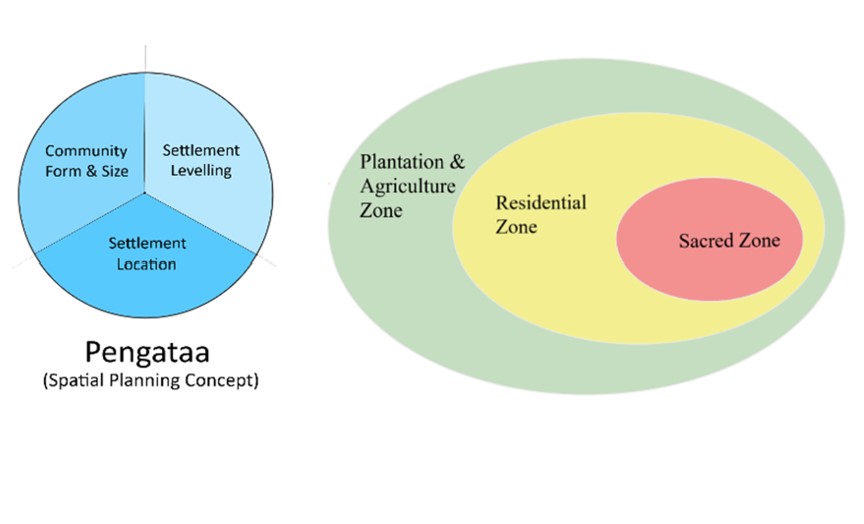
Indonesia has experienced multiple disasters induced by several active tectonic faults that cause earthquakes. Central Sulawesi, one of Indonesia's Province, has an active fault known as the Palu-Koro fault. This fault periodically causes disasters (i.e. earthquakes, tsunamis, liquefaction, and landslides). The co-occurrence of these four disasters is locally termed Nalodo. ToKaili – the native tribe that inhabited Central Sulawesi Province – has faced these hazards for generations and formulated local wisdom to minimise their impacts. This local wisdom is called Pengataa. Pengataa serves as a guideline for environmental management, such as determining the location of settlements in consideration of hazards and the environmental equilibrium. This study explores the customary spatial planning (Pengataa) of ToKaili in responding to natural disasters according to disaster records evidence, including the 2018 Palu disaster. This study uses a qualitative method and finds the role of Pengataa in organising ToKaili settlements to minimise the impact of disasters that are free from the effects of Nalodo. This study conveys that customary spatial planning of ToKaili is worthy of considering in the planning of residential areas, especially in relation to natural disasters.
References
Dalsgaard, P. (2014). Pragmatism and Design Thinking. International Journal of Design, 8(1), 143–155.
Darma, Y., Sulistyantara, B., & and Yonvitner, Y. (2020). Analysis of landscape impact on post-earthquake, tsunami, and liquefaction disasters in Palu City, Central Sulawesi. IOP Conference Series: Earth and Environmental Science, 501(1), 012003. http://dx.doi.org/10.1088/1755-1315/501/1/012003
Dayaratne, R. (2018). Toward sustainable development: Lessons from vernacular settlements of Sri Lanka. Frontiers of Architectural Research, 7(3), 334-346. https://doi.org/10.1016/j.foar.2018.04.002
Doxiadis, C. A. (1968). Ekistics: An Introduction to the Science of Human Settlements. Oxford University Press.
Estrella, M., & Saalismaa, N. (2013). Ecosystem-Based Disaster Risk Reduction (Eco-DRR): An Overview. In F. G. Renaud, K. Sudmeier-Rieux, & M. Estrella (Eds.), The Role of Ecosystems in Disaster Risk Reduction (pp. 26-54). United Nations University Press.
Fitriaty, P., Antaryama, I. G. N., & Ekasiwi, S. N. N. (2011). Thermal Performance of Traditional House in the Upland Central Celebes of Indonesia. IPTEK: The Journal for Technology and Science, 22(4),245–252. http://dx.doi.org/10.12962/ j20882033.v22i4.77
Fitriaty, P., Shen, Z., & Achsan, A. C. (2019). Daylighting Strategies in Tropical Coastal Area A Lesson From Vernacular Houses. International Review for Spatial Planning and Sustainable Development, 7(2), 75-91. https://doi.org/10.14246/ irspsd.7.2_75
Gou, S., Li, Z., Zhao, Q., Nik, V. M., & Scartezzini, J. L. (2015). Climate Responsive Strategies of Traditional Dwellings Located in an Ancient Village in Hot Summer and Cold Winter Region of China. Building and Environment, 86, 151–165. https://doi.org/10.1016/j.buildenv.2014.12.003
Hazarika, H., Rohit, D., Pasha, S. M. K., Maeda, T., Masyhur, I., Arsyad, A., & Nurdin, S. (2021). Large distance flow-slide at Jono-Oge due to the 2018 Sulawesi Earthquake, Indonesia. Soils and Foundations, 61(1), 239-255. https://doi.org/ 10.1016/j.sandf.2020.10.007
Healey, P. (2009). The Pragmatic Tradition in Planning Thought. Journal of Planning Education and Research, 28(3),277–292. https://doi.org/10.1177/0739456X 08325175
Husserl, E. (1982). Ideas Pertaining to a Pure Phenomenology and to a Phenomenological Philosophy First Book: General Introduction to a Pure Phenomenology (1st Ed.) Springer.
Huxley, M., & Inch, A. (2020). Urban Planning. In A. Kobayashi (Ed.), International Encyclopedia of Human Geography (87-92). Elsevier Science & Technology.
Jalil, A., Fathani, T. F., Satyarno, I., & Wilopo, W. (2021). Liquefaction in Palu: the cause of massive mudflows. Geoenvironmental Disasters, 8(21), 1-14. https://doi.org/ 10.1186/s40677-021-00194-y
Jha, A. K., Miner, T. W., & Stanton-Geddes, Z. (Eds.). (2013). Building urban resilience: principles, tools, and practice. World Bank Publications.
Johnson, D. P. (1986). Sociological Theory: Classical Founders and Contemporary Perspectives. Macmillan.
Kato, S., & Huang, W. (2021). Land use management recommendations for reducing the risk of downstream flooding based on a land use change analysis and the concept of ecosystem-based disaster risk reduction. Journal of Environmental Management, 287, 112341. https://doi.org/10.1016/j.jenvman.2021.112341
Kaudern, W. (1925). Ethnographical Studies in Celebes: Vol. 1 Structures and Settlements in Central Celebes. Elanders Boktryckeri Aktiebolag.
Lee, Y. J. (2017). Building resilient cities through community empowerment: principles and strategies for Taiwan. International review for spatial planning and sustainable development, 5(2), 35-46. https://dx.doi.org/10.14246/irspsd.5.2_35
Liao, K. H., Le, T. A., & Van Nguyen, K. (2016). Urban design principles for flood resilience: Learning from the ecological wisdom of living with floods in the Vietnamese Mekong Delta. Landscape and Urban Planning, 155, 69-78. https://doi.org/10.1016/j.landurbplan.2016.01.014
Mason, H. B., Montgomery, J., Gallant, A. P., Hutabarat, D., Reed, A. N., Wartman, J., ... & Yasin, W. (2021). East Palu Valley flowslides induced by the 2018 MW 7.5 Palu-Donggala earthquake. Geomorphology, 373, 107482. https://doi.org/ 10.1016/j.geomorph.2020.107482
McMillan, J. M., Birkmann, J., & Tangwanichagapong, S. (2021). Climate Risk Information as a Basis for Adaptive Spatial Planning: A Case Study from Thailand,” In Shrestha, S., Djalante, R., Shaw, R., & Pal, I. (Eds.), Disaster Resilience and Sustainability: Adaptation for Sustainable Development (301-320). Elsevier.
Montgomery, J., Wartman, J., Reed, A. N., Gallant, A. P., Hutabarat, D., & Mason, H. B. (2021). Field reconnaissance data from GEER investigation of the 2018 MW 7.5 Palu-Donggala earthquake. Data in Brief, 34, 106742. https://doi.org/ 10.1016/j.dib.2021.106742
Motealleh, P., Zolfaghari, M., & Parsaee, M. (2018). Investigating Climate Responsive Solutions in Vernacular Architecture of Bushehr City. HBRC Journal, 14(2), 215–223. https://doi.org/10.1016/j.hbrcj.2016.08.001
Nguyen, D., Imamura, F., & Iuchi, K. (2016). Disaster management in coastal tourism destinations: The case for transactive planning and social learning. International Review for Spatial Planning and Sustainable Development, 4(2), 3-17. https://dx.doi.org/10.14246/irspsd.4.2_3
Oliver, P. (1987). Dwellings, The House A Cross the World. University of Texas Press.
Oliver, T. H., Benini, L., Borja, A., Dupont, C., Doherty, B., Grodzińska-Jurczak, M., ... & Tarrason, L. (2021). Knowledge architecture for the wise governance of sustainability transitions. Environmental Science & Policy, 126, 152-163. https://doi.org/10.1016/j.envsci.2021.09.025
Panpakdee, C., Limnirankul, B., & Kramol, P. (2021). Assessing the Social-ecological Resilience of Organic Farmers in Chiang Mai Province, Thailand. Forest and Society, 5(2), 631-649. https://doi.org/10.24259/fs.v5i2.13268
Philokyprou, M., Michael, A., & Malaktou, E. (2021). A typological, environmental and socio-cultural study of semi-open spaces in the Eastern Mediterranean vernacular architecture: The case of Cyprus. Frontiers of Architectural Research, 10(3), 483-501. https://doi.org/10.1016/j.foar.2021.03.001
Poomchalit, W., Suzuki, K., & Suzuki, A. (2018). Review on the Relationship between the Spatial Developments and the Change of Wooden Houses in Original Settlements in the Suburban Expansion of Bangkok. International Review for Spatial Planning and Sustainable Development, 6(2), 12-29. https://doi.org/10.14246/ irspsd.6.2_12
Putnam, R. D., Leonardi, R., & Nanetti, R. Y. (1993). Making Democracy Work: Civic Traditions in Modern Italy. Princeton University Press.
Ramirez, R., Ravetz, J., Sharpe, B., & Varley, L. (2019). We need to talk (more wisely) about wisdom: A set of conversations about wisdom, science, and futures. Futures, 108, 72-80. https://doi.org/10.1016/j.futures.2019.02.002
Rapoport, A. (1969). House Form and Culture. Prentice-Hall.
Rapoport, A. (1977). Human Aspects of Urban Form Towards a Man — Environment Approach to Urban Form and Design. Pergamon Press.
Rohit, D., Hazarika, H., Maeda, T., Sumartini, W. O., Kokusho, T., Manafi Khajeh Pasha, S., & Nurdin, S. (2021). Forensic investigation of flowslides triggered by the 2018 Sulawesi earthquake. Progress in Earth and Planetary Science, 8(60), 1-20. https://doi.org/10.1186/s40645-021-00452-5
Sidiq, A. (2021). Critical Approaches to GIS and Spatial Mapping in Indonesia Forest Management and Conservation. Forest and Society, 5(2), 190-195. https://doi.org/10.24259/fs.v5i2.10921
Sirajuddin, Z. (2020). Local Wisdom as a Planning Strategy and Sustainable Settlement Development in ToKaili Traditional Settlement, Central Sulawesi, Indonesia. Review of European Studies, 12(2), 107–119. https://doi.org/10.5539/res. v12n2p107
Steiner, F. (2018). The Ecological Wisdom of Plan-Making. Journal of Urban Management, 7(3),124–130. https://doi.org/10.1016/j.jum.2018.04.004
Suleiman, S., & Himmo, B. (2012). Direct comfort ventilation. Wisdom of the past and technology of the future (wind-catcher). Sustainable Cities and Society, 5, 8-15. https://doi.org/10.1016/j.scs.2012.09.002
Usop, T. B., Sudaryono, S., & Roychansyah, M. S. (2022). Disempowering Traditional Spatial Arrangement of Dayak Community: A Case Study of Tumbang Marikoi Village, Central Kalimantan, Indonesia. Forest and Society, 6(1), 121-141. https://doi.org/10.24259/fs.v6i1.13472
Vagle, M. D., Clements, C. H., & Coffee, A. C. (2017). Analytic productions in post-intentional phenomenological research. Cultural Studies↔Critical Methodologies, 17(6), 427-441. https://doi.org/10.1177%2F153270861664 3983
Vitasurya, V. R. (2016). Local wisdom for sustainable development of rural tourism, case on Kalibiru and Lopati village, province of Daerah Istimewa Yogyakarta. Procedia-Social and Behavioral Sciences, 216, 97-108. https://doi.org/10.1016/j.sbspro. 2015.12.014
Wang, Y. C., Shen, J. K., Xiang, W. N., & Wang, J. Q. (2018). Identifying characteristics of resilient urban communities through a case study method. Journal of Urban Management, 7(3), 141-151. https://doi.org/10.1016/j.jum.2018.11.004
Winarto, Y., Santosa, H. R., & Ekasiwi, S. N. N. (2015). The climate conscious concept of Majapahit settlement in Trowulan, East Java. Procedia-Social and Behavioral Sciences, 179, 318-329. https://doi.org/10.1016/j.sbspro.2015.02.435
Yoshida, T., Yamagata, Y., Chang, S., de Gooyert, V., Seya, H., Murakami, D., ... & Voulgaris, G. (2020). Spatial modeling and design of smart communities. In Yamagata, Y., & Yang, P. P. J. (Eds.), Urban Systems Design (pp. 199-255). Elsevier.
Additional Files
Published
Issue
Section
Categories
License
Copyright (c) 2022 Forest and Society

This work is licensed under a Creative Commons Attribution 4.0 International License.
This is an open access journal which means that all contents is freely available without charge to the user or his/her institution. Users are allowed to read, download, copy, distribute, print, search, or link to the full texts of the articles in this journal without asking prior permission from the publisher or the author. This is in accordance with the BOAI definition of open access.
Submission of an article implies that the work described has not been published previously (except in the form of an abstract or as part of a published lecture or academic thesis), that it is not under consideration for publication elsewhere, that its publication is approved by all authors and tacitly or explicitly by the responsible authorities where the work was carried out, and that, if accepted, will not be published elsewhere in the same form, in English or in any other language, without the written consent of the Publisher. An article based on a section from a completed graduate dissertation may be published in Forest and Society, but only if this is allowed by author's(s') university rules. The Editors reserve the right to edit or otherwise alter all contributions, but authors will receive proofs for approval before publication.
Forest and Society operates a CC-BY 4.0 © license for journal papers. Copyright remains with the author, but Forest and Society is licensed to publish the paper, and the author agrees to make the article available with the CC-BY 4.0 license. Reproduction as another journal article in whole or in part would be plagiarism. Forest and Society reserves all rights except those granted in this copyright notice