
The Livelihood Adjustment of Smallholding Rubber Farming Systems (SRFS) in Southwestern Thailand: Case Study in Ranong, Krabi, Phangnga, and Phuket Provinces
DOI:
https://doi.org/10.24259/fs.v6i1.14159Keywords:
Rubber Livelihood, Rubber adaptation, Livelihood adjustment, Smallholding rubber farm, Southwestern ThailandAbstract
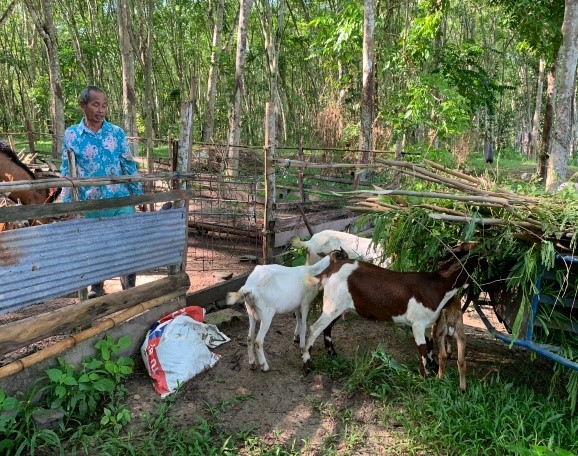
This study aimed to examine the livelihood adjustment, to analyze factors affecting, and to synthesize the relationships between production and livelihood adjustment in model of SRFS for Ranong, Krabi, Phangnga, and Phuket provinces, in Southwestern Thailand. A sample group of 399 rubber farmers was involved in data collection and 60 key informants were selected as a subsample. A structured interview form and a semi-structured interview form were the tools for data collection. In data analysis, descriptive statistics, linear regression and technical- economic simulation were applied, as well as synthesized model of connections between the production system and livelihood under SRFS was analyzed. The results indicate that rubber farming could be classified into four types: smallholding rubber monoculture farming system (S1) (40.9%), smallholding rubber with fruit tree farming system (S2) (35.8%), smallholding rubber with oil-palm farming system (S3) (49.8%), and smallholding rubber with livestock farming system (S4) (5.9%). These were different in livelihood assets and livelihood outcomes. Smallholding rubber with livestock farming system (S4) was better for livelihood outcomes than the other systems. The social capitals were quite high while the economic capitals were quite low. Livelihood strategies give importance to increasing productivity, reducing costs, financial management, and changes in food consumption. All farms relied on government support and received welfare. For the 10-year economic model (2017- 2026), S4 had the highest margin value. This study synthesized the relationships of production and livelihood adjustment model, showing that the model was composed of four sub-models: production system, support system, strategy, and livelihood adjustment system, and the resulting sustainable livelihood system will be useful for analyzing livelihood adjustments
References
Athipanan, W. (1999). Area and community analysis: Farming system concept in agricultural extension work. Agri-business Promotion Group.
Boonchu. P. (1990). Agricultural technical officers’ attitude toward farming system research. Department of Agricultural Development, Faculty of Natural Resources, Prince of Songkla University.
Cherdchom, P., Prommee, P., & Somboonsuke, B. (2002). Economic performances of small holding rubber-based farms in southern region Thailand: Case study in Khao Phra, Phijit, and Khlong Phea communities Songkhla Province. Kasetsart Journal of Social Sciences, 23(2), 151-166.
Choengsa-at, U. (1991). Integrated agricultural system. Agri-business Promotion Group, Department of Agricultural Extension.
OSM Adaman (2018). Southern Adaman Coast province group development plan 2018-2021 (Ranong, Krabi, Phangnga, Trang and Phuket Provinces). The Office of Strategy Management: Southern Gulf of Thailand Provincial Cluster.
Nusang, R. (2006). The socio-economic adjustment of rubber smallholders in smallholding rubber-rice farming system in Khao Chaison, Amphoe Khao Chaison, Changwat Phatthalung [Unpublished master’s thesis]. Prince of Songkla University.
Office of the National Economic and Social Development Board. (2019). Thai Economic Performance in Q1 2019 and Outlook for 2019. Office of the National Economic and Social Development Council.
Office of Agricultural Economics. (2019). Agricultural production data. Retrieved from: http://www.oae.go.th/production.html.
Rubber Authority of Thailand (RAOT). (2019). Rubber information: Rubber database system. Retrieved from http://emarket.raot.co.th/rdu/.
Simien, A., & Penot, E. (2011). Current evolution of smallholder rubber-based farming systems in southern Thailand. Journal of Sustainable Forestry, 30(3), 247-260. https://doi.org/10.1080/10549811.2011.530936
Stroesser, L., Prnot, E., Michel, I., Tongkaemkaew, U., and Chambon, B. (2016). Income diversification for rubber farmers through agro-forestry practices: How to overcome rubber prices volatility in Phatthalung province, Thailand. Proceeding on CRRI and IRRDB International Rubber conference 2016.
Somboonsuke, B., Pacheerat, K. and Wettayaprasit, P. (2009). A Socio-economic simulation of rubber smallholding systems: A Case study of Phatthalung and Songkhla provinces in southern Thailand. CMU Journal of Social Sciences and Humanities, 3, 113-134.
Somboonsuke, B., Demaine, H. and Shivakoti, G. P. (2002). Rubber-based farming system in Thailand: Problems, Potential, Solution, and Constraints. Journal of Rural Development, 21(1): 91-97.
The Department for International Development (DFID). (2001). Sustainable livelihoods guidance sheets. DFID.
Warren‐Thomas, E., Nelson, L., Juthong, W., Bumrungsri, S., Brattström, O., Stroesser, L., ... & Dolman, P. M. (2020). Rubber agroforestry in Thailand provides some biodiversity benefits without reducing yields. Journal of Applied Ecology, 57(1), 17-30. https://doi.org/10.1111/1365-2664.13530
Additional Files
Published
Issue
Section
Categories
License
Copyright (c) 2022 Forest and Society

This work is licensed under a Creative Commons Attribution 4.0 International License.
This is an open access journal which means that all contents is freely available without charge to the user or his/her institution. Users are allowed to read, download, copy, distribute, print, search, or link to the full texts of the articles in this journal without asking prior permission from the publisher or the author. This is in accordance with the BOAI definition of open access.
Submission of an article implies that the work described has not been published previously (except in the form of an abstract or as part of a published lecture or academic thesis), that it is not under consideration for publication elsewhere, that its publication is approved by all authors and tacitly or explicitly by the responsible authorities where the work was carried out, and that, if accepted, will not be published elsewhere in the same form, in English or in any other language, without the written consent of the Publisher. An article based on a section from a completed graduate dissertation may be published in Forest and Society, but only if this is allowed by author's(s') university rules. The Editors reserve the right to edit or otherwise alter all contributions, but authors will receive proofs for approval before publication.
Forest and Society operates a CC-BY 4.0 © license for journal papers. Copyright remains with the author, but Forest and Society is licensed to publish the paper, and the author agrees to make the article available with the CC-BY 4.0 license. Reproduction as another journal article in whole or in part would be plagiarism. Forest and Society reserves all rights except those granted in this copyright notice