
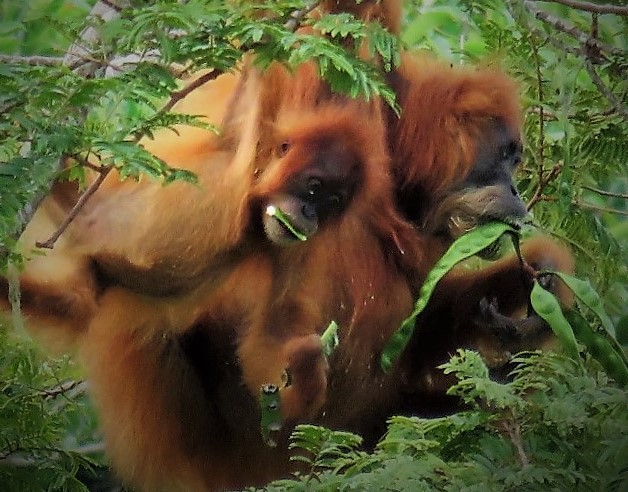
Population Status of Tapanuli Orangutan (Pongo tapanuliensis) within the Renewable Energy Development and its Management Implications
DOI:
https://doi.org/10.24259/fs.v5i2.13529Keywords:
Tapanuli, Orangutans, Hydroelectric dam, Batang Toru, Renewable energyAbstract
To protect Tapanuli orangutan it is essential to understand the actual situation. It has been studied 15% of its population live outside the protected area facing a density disruption due to forest conversion. Several best management practices have been created and tested for different natural concession types. Yet, the main objective to reduce the impact and increase wildlife survival is far away from the goal. To improve our understanding of the species survival within ongoing project construction, we conducted population density monitoring prior- to post-construction time frames within the hydroelectric dam project. Also, we carried out spatial analysis to understand the land cover change and orangutan’s suitable habitat distribution. This study found that during high construction activities, orangutans were avoiding the threat sources, and returned when the disturbances reduced. These findings indicated orangutans are ecology flexible and have the capability to increase its survival, although the company’s involvement is crucial to facilitate the successes. Our study is based on indirect observation, and spatial modeling, which may lead to an uncertain conclusion. Further research on orangutan ecology and behavior is prioritized.
References
Abram, N. K., Meijaard, E., Wells, J. A., Ancrenaz, M., Pellier, A.-S., Runting, R. K., . . . Richardson, D. (2015). Mapping perceptions of species' threats and population trends to inform conservation efforts: the Bornean orangutan case study. Diversity and Distributions, 21(5), 487-499. https://doi.org/10.1111/ddi.12286
Ancrenaz, M. (2010). Orang-utan bridges in lower Kinabatangan. Retrieved from https://www.arcusfoundation.org/wp-content/uploads/2010/01/Kinabatangan-Orangutan-Rope-Bridges-Ancrenaz-2010.pdf
Ancrenaz, M., Oram, F., Nardiyono, N., Silmi, M., Jopony, M. E. M., Voigt, M., . . . Meijaard, E. (2021). Importance of Small Forest Fragments in Agricultural Landscapes for Maintaining Orangutan Metapopulations. Frontiers in Forests and Global Change, 4, 560944, 1-7. https://doi.org/10.3389/ffgc.2021.560944
Balitbang-LHK-Aek-Nauli, & BBKSDA-Sumatera-Utara. (2018). Laporan Kegiatan Analisis Populasi Orangutan dan Satwa Langka Lainnya Pada Musim Kering di Wilayah Kerja PT. NSHE, Tapanuli Selatan. BP2LHK Aek Nauli dan BBKSDA Sumatera Utara.
Cantor, S. B., Sun, C. C., Tortolero-Luna, G., Richards-Kortum, R., & Follen, M. (1999). A comparison of C/B ratios from studies using receiver operating characteristic curve analysis. Journal of clinical epidemiology, 52(9), 885-892. https://doi.org/10.1016/S0895-4356(99)00075-X
Davis, J. T., Mengersen, K., Abram, N. K., Ancrenaz, M., Wells, J. A., & Meijaard, E. (2013). It's not just conflict that motivates killing of orangutans. PloS one, 8(10), e75373. https://doi.org/10.1371/journal.pone.0075373
Fielding, A. H., & Bell, J. F. (1997). A review of methods for the assessment of prediction errors in conservation presence/absence models. Environmental Conservation, 24(1), 38-49. https://doi.org/10.1017/S0376892997000088
Hardus, M. E., Lameira, A. R., Menken, S. B. J., & Wich, S. A. (2012). Effects of logging on orangutan behavior. Biological Conservation, 146(1), 177-187. https://doi.org/10.1016/j.biocon.2011.12.014
Hosmer, D. W., & Lemeshow, S. (2000). Applied Logistic Regression (2 ed.). John Wiley & Sons. https://doi.org/10.1002/0471722146
Knop, E., Ward, P. I., & Wich, S. A. (2004). A comparison of orang-utan density in a logged and unlogged forest on Sumatra. Biological Conservation, 120(2), 183-188. https://doi.org/10.1016/j.biocon.2004.02.010
Knott, C. D. (1998). Changes in orangutan caloric intake, energy balance, and ketones in response to fluctuating fruit availability. International Journal of Primatology, 19(6), 1061-1079. https://doi.org/10.1023/A:1020330404983
Kuswanda, W., Harahap, R. H., Alikodra, H. S., & Sibarani, R. (2020). Nest characteristics and populations of Tapanuli Orangutans in the conflict areas, Batangtoru Landscape, North Sumatra, Indonesia. Biodiversitas Journal of Biological Diversity, 21(7), 3398-3406. https://doi.org/10.13057/biodiv/d210765
Kuswanda, W., & Noor CH, F. (2017). Laporan Hasil Survai: Analisis Populasi Orangutan dan Satwa Lainnya pada Wilayah Kerja PT. NSHE di Batang Toru.
Linkie, M., Smith, R. J., & Leader-Williams, N. (2004). Mapping and predicting deforestation patterns in the lowlands of Sumatra. Biodiversity & Conservation, 13(10), 1809-1818. https://doi.org/10.1023/B:BIOC.0000035867.90891.ea
Liu, C., Berry, P. M., Dawson, T. P., & Pearson, R. G. (2005). Selecting thresholds of occurrence in the prediction of species distributions. Ecography, 28(3), 385-393. https://doi.org/10.1111/j.0906-7590.2005.03957.x
MacKenzie, D. I., Nichols, J. D., Royle, J. A., Pollock, K. H., Bailey, L. L., & Hines, J. E. (2006). Occupancy Estimation and Modeling: Inferring Patterns and Dynamics of Species Occurrence. Elsevier/Academic Press.
Meijaard, E., Albar, G., Nardiyono, Rayadin, Y., Ancrenaz, M., & Spehar, S. (2010). Unexpected Ecological Resilience in Bornean Orangutans and Implications for Pulp and Paper Plantation Management. PLoS One, 5(9), e12813. https://doi.org/10.1371/journal.pone.0012813
Meijaard, E., Buchori, D., Hadiprakarsa, Y., Utami-Atmoko, S. S., Nurcahyo, A., Tjiu, A., & Prasetyo, D. (2012). Correction: Quantifying Killing of Orangutans and Human-Orangutan Conflict in Kalimantan, Indonesia. PLoS One, 7(3). https://doi.org/10.1371/annotation/7b65cf64-9fd5-4b95-baf2-8824c4785ab1
Meijaard, E., Buchori, D., Hadiprakarsa, Y., Utami-Atmoko, S. S., Nurcahyo, A., Tjiu, A., . . . Mengersen, K. (2011). Quantifying killing of orangutans and human-orangutan conflict in Kalimantan, Indonesia. PLoS One, 6(11), e27491. https://doi.org/10.1371/journal.pone.0027491
Meijaard, E., Ni'matullah, S., Dennis, R., Sherman, J., Onrizal, & Wich, S. A. (2021). The historical range and drivers of decline of the Tapanuli orangutan. PLoS One, 16(1), e0238087. https://doi.org/10.1371/journal.pone.0238087
Meijaard, E., Sheil, D., Nasi, R., Augeri, D., Rosenbaum, B., Iskandar, D., . . . O’Brien, T. (2005). Life after logging: Reconciling wildlife conservation and production forestry in Indonesian Borneo. CIFOR. https://doi.org/10.17528/cifor/001663
Nasution, A., Perwitasari-Farajallah, D. Y. A. H., & Utami-Atmoko, S. S. (2020). The distribution and density of Tapanuli orangutans (Pongo tapanuliensis) at potential corridor locations between forest fragments in Batang Toru, North Sumatra, Indonesia. Biodiversitas Journal of Biological Diversity, 21(11), 5382-5388. https://doi.org/10.13057/biodiv/d211144
Nasution, A., Perwitasari-Farajallah, D., & Utami Atmoko, S. S. (2018). Declining orangutans population in the unprotected forest of Batang Toru. Tropical Life Sciences Research, 29(2), 77-87. https://dx.doi.org/10.21315%2Ftlsr2018.29.2.6
Nater, A., Mattle-Greminger, M. P., Nurcahyo, A., Nowak, M. G., de Manuel, M., Desai, T., . . . Krutzen, M. (2017). Morphometric, Behavioral, and Genomic Evidence for a New Orangutan Species. Current Biology, 27(22), 3487-3498. https://doi.org/10.1016/j.cub.2017.09.047
Nowak, M. G., Rianti, P., Wich, S. A., Meijaard, E., & Fredriksson, G. (2017). Pongo tapanuliensis. The IUCN Red List of Threatened Species 2017. https://dx.doi.org/10.2305/IUCN.UK.2017-3.RLTS.T120588639A120588662.en
Pasaribu, N., Aththorick, T. A., & Siswiyati, E. (2018). Study of Ficus in West Block Batang Toru Forest Region, North Tapanuli District, Indonesia. Journal of Physics: Conference Series, 1116(5), 1-6. https://doi.org/10.1088/1742-6596/1116/5/052049
Pearce, J., & Ferrier, S. (2000). Evaluating the predictive performance of habitat models developed using logistic regression. Ecological Modelling, 133(3), 225-245. https://doi.org/10.1016/S0304-3800(00)00322-7
Phillips, S. J., Anderson, R. P., & Schapire, R. E. (2006). Maximum entropy modeling of species geographic distributions. Ecological Modelling, 190(3-4), 231-259. https://doi.org/10.1016/j.ecolmodel.2005.03.026
Prasetyo, D. (2011). Nest density as determinants for habitat utilizations of Bornean orangutan (Pongo pygmaeus wurmbii) in degraded forests of Gunung Palung National Park, West Kalimantan. Biodiversitas, Journal of Biological Diversity, 12(1), 164-170. https://doi.org/10.13057/biodiv/d120306
Prasetyo, D., Misdi, M., Mulyana, T., Cholifatullah, F., Sadjudin, H., Kuswanda, W., & Sugardjito, J. (2021). Preliminary survey of the southernmost Tapanuli orangutan population. Oryx, 55(4), 495-495. https://doi.org/10.1017/S0030605321000491
Rahman, D. A., Rinaldi, D., Kuswanda, W., Siregar, R., Noor CH, F., Hakim, F., . . . Putro, H. R. (2019). Determining the landscape priority and their threats for the critically endangered Pongo tapanuliensis population in Indonesia. Biodiversitas Journal of Biological Diversity, 20(12), 3584-3592. https://doi.org/10.13057/biodiv/d201217
Rosoman, G., Sheun, S. S., Opal, C., Anderson, P., & Trapshah, R. (2017). The HCS Approach Toolkit. HCS Approach Steering Group
Sanderson, E. W., Redford, K. H., Vedder, A., Coppolillo, P. B., & Ward, S. E. (2002). A conceptual model for conservation planning based on landscape species requirements. Landscape and Urban Planning, 58(1), 41-56. https://doi.org/10.1016/S0169-2046(01)00231-6
Schadt, S., Knauer, F., Kaczensky, P., Revilla, E., Wiegand, T., & Trepl, L. (2002). Rule-based assessment of suitable habitat and patch connectivity for the eurasian lynx. Ecological Applications, 12(5), 1469-1483. https://doi.org/10.1890/1051-0761(2002)012[1469:RBAOSH]2.0.CO;2
Sloan, S., Alamgir, M., Campbell, M. J., Setyawati, T., & Laurance, W. F. (2019). Development Corridors and Remnant-Forest Conservation in Sumatra, Indonesia. Tropical Conservation Science, 12, 1-9. https://doi.org/10.1177%2F1940082919889509
Sloan, S., Supriatna, J., Campbell, M. J., Alamgir, M., & Laurance, W. F. (2018). Newly discovered orangutan species requires urgent habitat protection. Current Biology, 28(11), R650-R651. https://doi.org/10.1016/j.cub.2018.04.082
Sunarto, S., Kelly, M. J., Parakkasi, K., Klenzendorf, S., Septayuda, E., & Kurniawan, H. (2012). Tigers need cover: multi-scale occupancy study of the big cat in Sumatran forest and plantation landscapes. PLoS One, 7(1), e30859. https://doi.org/10.1371/journal.pone.0030859
Swets, J. A. (1988). Measuring the Accuracy of Diagnostic Systems. Science, 240(4857), 1285-1293. https://doi.org/10.1126/science.3287615
Thomas, L., Buckland, S. T., Rexstad, E. A., Laake, J. L., Strindberg, S., Hedley, S. L., . . . Burnham, K. P. (2010). Distance software: design and analysis of distance sampling surveys for estimating population size. Journal of Applied Ecology, 47(1), 5-14. https://doi.org/10.1111/j.1365-2664.2009.01737.x
Utami-Atmoko, S., Traylor-Holzer, K., Rifqi, M. A., Siregar, P. G., Achmad, B., Priadjati, A., . . . Lees, C. M. (2019). [Unpublished] Orangutan Population and Habitat Viability Assessment: Final Report. Retrieved from www.cpsg.org and www.forina.or.id
Utami-Atmoko, S. S., Traylor-Holzer, K., Rifqi, M. A., Siregar, P. G., Achmad, B., Priadjati, A., . . . Lees, C. M. (2017). Orangutan Population and Habitat Viability Assessment: Final Report. Retrieved from www.cpsg.org and www.forina.or.id
van Schaik, C. P., Azwar., & Priatna, D. (1995). Population Estimates and Habitat Preferences of Orangutans Based on Line Transects of Nests. In Nadler R.D., Galdikas B.F.M., Sheeran L.K., Rosen N. (eds) The Neglected Ape. Springer. https://doi.org/10.1007/978-1-4899-1091-2_15
van Schaik, C. P., Wich, S. A., Utami, S. S., & Odom, K. (2005). A simple alternative to line transects of nests for estimating orangutan densities. Primates, 46(4), 249-254. https://doi.org/10.1007/s10329-005-0134-z
Vogel, E. R., Haag, L., Mitra-Setia, T., van Schaik, C. P., & Dominy, N. J. (2009). Foraging and ranging behavior during a fallback episode: Hylobates albibarbis and Pongo pygmaeus wurmbii compared. American Journal of Physical Anthropology: The Official Publication of the American Association of Physical Anthropologists, 140(4), 716-726. https://doi.org/10.1002/ajpa.21119
Vogel, E. R., Knott, C. D., Crowley, B. E., Blakely, M. D., Larsen, M. D., & Dominy, N. J. (2012). Bornean orangutans on the brink of protein bankruptcy. Biology Letter, 8(3), 333-336. https://dx.doi.org/10.1098%2Frsbl.2011.1040
Voigt, M., Wich, S. A., Ancrenaz, M., Meijaard, E., Abram, N., Banes, G. L., . . . Kuhl, H. S. (2018). Global Demand for Natural Resources Eliminated More Than 100,000 Bornean Orangutans. Current Biology, 28(5), 761-769. https://doi.org/10.1016/j.cub.2018.01.053
Wich, S. A., & Boyko, R. H. (2011). Which factors determine orangutan nests’ detection probability along transects? Tropical Conservation Science, 4(1), 53-63. https://doi.org/10.1177%2F194008291100400106
Wich, S. A., Fredriksson, G., Usher, G., Kuhl, H. S., & Nowak, M. G. (2019). The Tapanuli orangutan: Status, threats, and steps for improved conservation. Conservation Science and Practice, 1(6), 1-4. https://doi.org/10.1111/csp2.33
Wich, S. A., Fredriksson, G. M., Usher, G., Peters, H. H., Priatna, D., Basalamah, F., . . . Kühl, H. (2012). Hunting of Sumatran orang-utans and its importance in determining distribution and density. Biological Conservation, 146(1), 163-169. https://doi.org/10.1016/j.biocon.2011.12.006
Wich, S. A., Meijaard, E., Marshall, A. J., Husson, S., Ancrenaz, M., Lacy, R. C., . . . Singleton, I. (2008). Distribution and conservation status of the orang-utan (Pongo spp.) on Borneo and Sumatra: how many remain? Oryx, 43(3), 329-339. https://doi.org/10.1017/S003060530800197X
Wich, S. A., Singleton, I., Nowak, M. G., Utami-Atmoko, S. S., Nisam, G., Arif, S. H., . . . Kühl, H. S. (2016). Land-cover changes predict steep declines for the Sumatran orangutan (Pongo abelii). Science Advances, 2(3), 1-8. https://dx.doi.org/10.1126%2Fsciadv.1500789
Wilting, A., Christiansen, P., Kitchener, A. C., Kemp, Y. J., Ambu, L., & Fickel, J. (2011). Geographical variation in and evolutionary history of the Sunda clouded leopard (Neofelis diardi) (Mammalia: Carnivora: Felidae) with the description of a new subspecies from Borneo. Molecular Phylogenetics and Evolution, 58(2), 317-328. https://doi.org/10.1016/j.ympev.2010.11.007
Additional Files
Published
Issue
Section
Categories
License
Copyright (c) 2021 Forest and Society

This work is licensed under a Creative Commons Attribution 4.0 International License.
This is an open access journal which means that all contents is freely available without charge to the user or his/her institution. Users are allowed to read, download, copy, distribute, print, search, or link to the full texts of the articles in this journal without asking prior permission from the publisher or the author. This is in accordance with the BOAI definition of open access.
Submission of an article implies that the work described has not been published previously (except in the form of an abstract or as part of a published lecture or academic thesis), that it is not under consideration for publication elsewhere, that its publication is approved by all authors and tacitly or explicitly by the responsible authorities where the work was carried out, and that, if accepted, will not be published elsewhere in the same form, in English or in any other language, without the written consent of the Publisher. An article based on a section from a completed graduate dissertation may be published in Forest and Society, but only if this is allowed by author's(s') university rules. The Editors reserve the right to edit or otherwise alter all contributions, but authors will receive proofs for approval before publication.
Forest and Society operates a CC-BY 4.0 © license for journal papers. Copyright remains with the author, but Forest and Society is licensed to publish the paper, and the author agrees to make the article available with the CC-BY 4.0 license. Reproduction as another journal article in whole or in part would be plagiarism. Forest and Society reserves all rights except those granted in this copyright notice