
Land-Use Changes and Food Insecurity around Oil Palm Plantations: Evidence at the Village Level
DOI:
https://doi.org/10.24259/fs.v5i2.11376Keywords:
independent smallholders, land conversion, residual pockets of land, single commodityAbstract
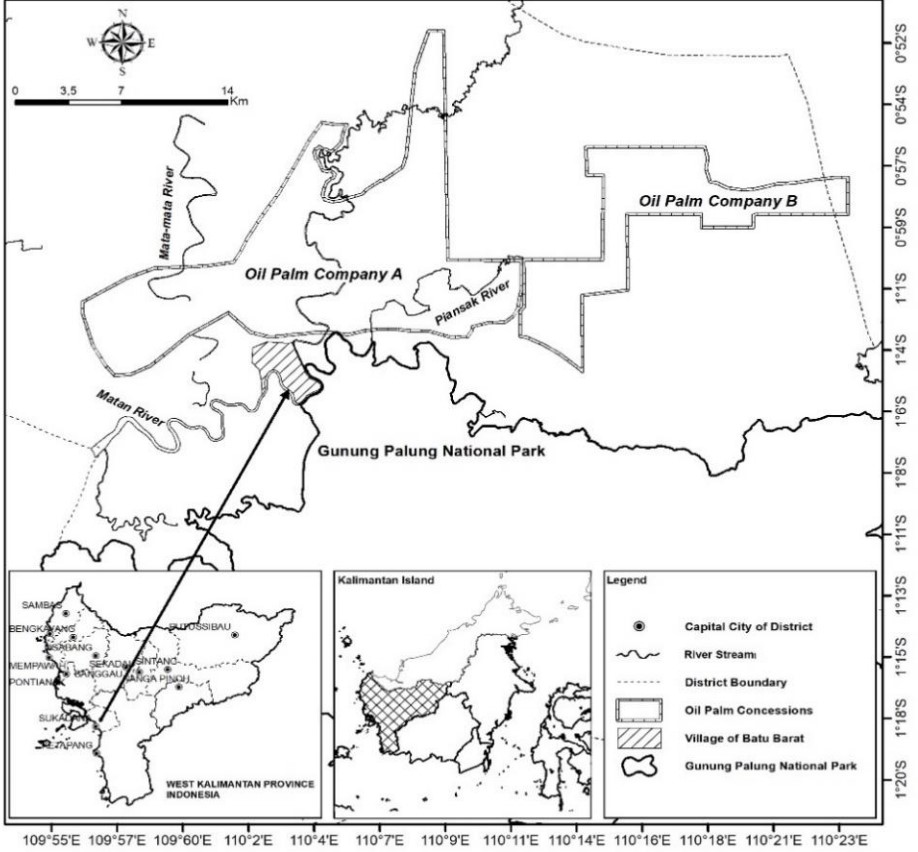
Land conversion of oil palm plantations in the villages of West Kalimantan has caused drastic changes in how farmers fulfill their basic household needs. One such change affects farmers’ food security. This study aimed to explain the deterioration of food self-sufficiency at the village level due to the pressure to use residual pockets of land for oil palm cultivation. The collected evidence was analyzed through an assessment of their residual pockets of land in a single village. A case study survey collected data from July until September 2019 in the village of Batu Barat, district of Kayong Utara, West Kalimantan Province, Indonesia. The study utilized 70 family heads as samples for interviews. They were selected through a simple random sampling technique. We used descriptive quantitative and qualitative methods in our investigation. The results confirmed that the current utilization of the village’s residual lands actually entails even greater food insecurity for farmers, as exemplified by a sizeable decrease in rice fields to merely an estimated 0.59 hectares per household. By contrast, the land utilized by independent smallholders of oil palm cultivation increased to an average of approximately 0.67 hectares per household. This land conversion not only exacerbated food-farmland availability but
References
Abram, N.K., Meijaard, E., Wilson, K.A., Davis, J.T., Wells, J.A., Ancrenaz, M., Budiharta, S., Durrant, A., Fakhruzzi, A., Runting, R.K., Gaveau, D., & Mengersen, K. (2017). Oil palm–community conflict mapping in Indonesia: A case for better community liaison in planning for development initiatives. Applied Geography, 78, 33-44. https://doi.org/10.1016/j.apgeog.2016.10.005
Belcher, B., Rujehan, Imang, N., & Achdiawan, R. (2004). Rattan, Rubber, or Oil Palm: Cultural and Financial Considerations for Farmers in Kalimantan. Economic Botany, 58, 77- 87.
Bou Dib, J., Alamsyah, Z., & Qaim, M. (2018). Land-use change and income inequality in rural Indonesia. Forest Policy and Economics, 94, 55-66. https://doi.org/10.1016/j.forpol.2018.06.010
Budidarsono, S., Dewi, S., Sofiyuddin, M., & Rahmanulloh, A. (2012a). Socioeconomic Impact Assessment of Palm Oil Production. Technical Brief No. 27: Palm Oil Series. Bogor, Indonesia: World Agroforestry Centre-(ICRAF), SEA Regional Office. 4p.
Budidarsono, S., Rahmanulloh, A., & Sofiyuddin, M. (2012b). Economic Assessment of Palm Oil Production. Technical Brief No. 26: Palm Oil Series. Bogor, Indonesia: World Agroforestry Centre-(ICRAF), SEA Regional Office. 6p.
Cahyadi, E.R. & Waibel, H. (2015). Contract Farming and Vulnerability to Poverty among Oil Palm Smallholders in Indonesia. The Journal of Development Studies, 52(5), 681-695. https://doi.org/10.1080/00220388.2015.1098627
Chakraborty, D. & Kuri, P.K. (2017). The Household Level Determinants in the Choice and Level of Migration: A Micro Study in West Bengal. Environment and Urbanization ASIA, 8(1), 94-104. https://doi.org/10.1177/0975425316683864
de Vos, R.E. (2016). Multi-Functional Lands Facing Oil Palm Monocultures: A Case Study of a Land Conflict in West Kalimantan, Indonesia. Austrian Journal of South-East Asian Studies, 9(1), 11-32.
Dharmawan, A.H., Mardiyaningsih, D.I., Komarudin, H., Ghazoul, J., Pacheco, P., & Rahmadian, F. (2020). Dynamics of Rural Economy: A Socio-Economic Understanding of Oil Palm Expansion and Landscape Changes in East Kalimantan, Indonesia. Land, 9, 213. https://doi.org/10.3390/land9070213
Dharmawan, A.H., Mardiyaningsih, D.I., & Yulian, B.E. (2016). Ekspansi Perkebunan Kelapa Sawit dan Perubahan Sosial, Ekonomi dan Ekologi Pedesaan: Studi Kasus di Kutai Kartanegara. Project Working Paper Series OPAL (Oil Palm Adaptive Landscapes) No. 1. Pusat Studi Pembangunan Pertanian dan Pedesaan-Institut Pertanian Bogor.
Diantoro, T.D. (2011). Perambahan Kawasan Hutan pada Konservasi Taman Nasional (Studi Kasus Taman Nasional Tesso Nilo, Riau). Mimbar Hukum, 23(3), 546-565. https://doi.org/10.22146/jmh.16176
Elmhirst, R., Siscawati, M., Basnett, B.S., & Ekowati, D. (2017). Gender and generation in engagements with oil palm in East Kalimantan, Indonesia: Insights from feminist political ecology. The Journal of Peasant Studies, 44(6), 1135-1157. https://doi.org/10.1080/03066150.2017.1337002
Euler, M., Krishna, V., Schwarze, S., Siregar, H., & Qaim, M. (2017). Oil Palm Adoption, Household Welfare, and Nutrition Among Smallholder Farmers in Indonesia. World Development, 93, 219-235. https://doi.org/10.1016/j.worlddev.2016.12.019
Euler, M., Schwarze, S., Siregar, H., & Qaim, M. (2016). Oil Palm Expansion among Smallholder Farmers in Sumatra, Indonesia. Journal of Agricultural Economics, 67(3), 658-676. https://doi.org/10.1111/1477-9552.12163
Fadjar, U. (2006). Kemitraan Usaha Perkebunan: Perubahan Struktur yang Belum Lengkap. Forum Penelitian Agro Ekonomi, 24(1), 46-60. http://dx.doi.org/10.21082/fae.v24n1.2006.46-60
Feintrenie, L., Chong, W. K., & Levang, P. (2010). Why do Farmers Prefer Oil Palm? Lessons Learnt from Bungo District, Indonesia. Small-Scale Forestry, 9(3), 379-396. https://doi.org/10.1007/s11842-010-9122-2
Gebru, G.W., Ichoku, H.E., & Phil-Eze, P.O. (2018). Determinants of livelihood diversification strategies in Eastern Tigray Region of Ethiopia. Agriculture & Food Security, 7(1), 62. https://doi.org/10.1186/s40066-018-0214-0
Hidayah, N., Dharmawan, A.H., & Barus, B. (2016). Ekspansi Perkebunan Kelapa Sawit dan Perubahan Sosial Ekologi Pedesaan. Sodality: Jurnal Sosiologi Pedesaan, 4(3), 249- 256. https://doi.org/10.22500/sodality.v4i3.14434
Julia & White, B. (2012). Gendered experiences of dispossession: Oil palm expansion in a Dayak Hibun community in West Kalimantan. The Journal of Peasant Studies, 39(3-4), 995-1016. https://doi.org/10.1080/03066150.2012.676544
Koczberski, G., Curry, G.N., & Bue, V. (2012). Oil palm, food security and adaptation among smallholder households in Papua New Guinea. Asia Pacific Viewpoint, 53(3), 288-299. https://doi.org/10.1111/j.1467-8373.2012.01491.x
Li, T.M. (2017). Intergenerational displacement in Indonesia’s oil palm plantation zone. The Journal of Peasant Studies, 44(6), 1158–1176. https://doi.org/10.1080/03066150.2017.1308353
McCarthy, J.F. (2010). Processes of inclusion and adverse incorporation: Oil palm and agrarian change in Sumatra, Indonesia. The Journal of Peasant Studies, 37(4), 821–850. https://doi.org/10.1080/03066150.2010.512460
Meijaard, E., Garcia-Ulloa, J., Sheil, D., Wich, S.A., Carlson, K.M., Juffe-Bignoli, D., & Brooks, T.M. (eds.) (2018). Oil palm and biodiversity. A situation analysis by the IUCN Oil Palm Task Force. IUCN Oil Palm Task Force Gland, Switzerland: IUCN. Xiii + 116pp. https://doi.org/10.2305/IUCN.CH.2018.11.en
Mukti, A., Setiawan. B., Pramoedyo, H., & Fatah, L. (2014). The Impact of Palm Oil Plantation Development towards Income Disparity. Academic Research International, 5(2), 96-106.
Nesadurai, H.E.S. (2013). Food security, the palm oil-land conflict nexus, and sustainability: a governance role for a private multi-stakeholder regime like RSPO?. The Pacific Review, 26(5), 505-529. http://dx.doi.org/10.1080/09512748.2013.842311
Obidzinski, K., Andriani, R., Komarudin, H., & Andrianto, A. (2012). Environmental and Social Impacts of Oil Palm Plantations and their Implications for Biofuel Production in Indonesia. Ecology and Society, 17(1), art25. https://doi.org/10.5751/ES-04775-170125
Rist, L., Feintrenie, L., & Levang, P. (2010). The livelihood impacts of oil palm: Smallholders in Indonesia. Biodiversity and Conservation, 19(4), 1009-1024. https://doi.org/10.1007/s10531-010-9815-z
Santika, T., Wilson, K.A., Budiharta, S., Law, E.A., Poh, T.M., Ancrenaz, M., Struebig, M.J., & Meijaard, E. (2019a). Does oil palm agriculture help alleviate poverty? A multidimensional counterfactual assessment of oil palm development in Indonesia. World Development, 120, 105-117. https://doi.org/10.1016/j.worlddev.2019.04.012
Santika, T., Wilson, K.A., Meijaard, E., Budiharta, S., Law, E.E., Sabri, M., Struebig, M., Ancrenaz, M., & Poh, T.-M. (2019b). Changing landscapes, livelihoods and village welfare in the context of oil palm development. Land Use Policy, 87, 104073. https://doi.org/10.1016/j.landusepol.2019.104073
Schwarze, S., Euler, M., Gatto, M., Hein, J., Hettig, E., Holtkamp, A. M., Izhar, L., Kunz, Y., Lay, J., Merten, J., Moser, S., Mußhoff, O., Otten, F., Qaim, M., Soetarto, E., Steinebach, S., Trapp, K., Vorlaufer, M., & Faust, H. (2015). Rubber vs. oil palm: an analysis of factors influencing smallholders’ crop choice in Jambi, Indonesia. EFForTS, Ecological and Socioeconomic Functions of Tropical Lowland Rainforest Transformation Systems (Sumatra, Indonesia), Discussion Paper Series No. 11. Georg-August-Universität Göttingen.
Scoones, I. (2009). Livelihoods perspectives and rural development. The Journal of Peasant Studies, 36(1), 171-196. https://doi.org/10.1080/03066150902820503
Semedi, P. (2014). Palm Oil Wealth and Rumour Panics in West Kalimantan. Forum for Development Studies, 41(2), 233-252. https://doi.org/10.1080/08039410.2014.901240
Semedi, P. & Bakker, L. (2014). Between Land Grabbing and Farmers’ Benefits: Land Transfers in West Kalimantan, Indonesia. The Asia Pacific Journal of Anthropology, 15(4), 376-390. https://doi.org/10.1080/14442213.2014.928741
Sinaga, H. (2013). Employment and income of workers on Indonesian oil palm plantations: food crisis at the micro-level. Future of Food: Journal on Food, Agriculture and Society, 1(2), 64-78.
Susanti, A. & Burgers, P. (2013). Oil Palm Expansion: Competing Claim of Lands for Food, Biofuels, and Conservation. In Behnassi et al. (Eds.), Sustainable Food Security in the Era of Local and Global Environmental Change (301-320). Dordrecht¬, Netherland: Springer. https://doi.org/10.1007/978-94-007-6719-5_19
Vanwey, L.K. (2003). Land Ownership as a Determinant of Temporary Migration in Nang Rong, Thailand. Europen Journal of Population, 19(2), 121–145.
White, B. (2012). Agriculture and the Generation Problem: Rural Youth, Employment and the Future of Farming. IDS Bulletin, 43(6), 9-19. https://doi.org/10.1111/j.1759-5436.2012.00375.x
Zahri, I., Wildayana, E., Ak, A.T., Adriani, D., & Harun, M.U. (2019). Impact of conversion from rice farms to oil palm plantations on socio-economic aspects of ex-migrants in Indonesia. Agricultural Economics, 65(12), 579-586. https://doi.org/10.17221/349/2018-AGRICECON
Additional Files
Published
Issue
Section
Categories
License
Copyright (c) 2021 Forest and Society

This work is licensed under a Creative Commons Attribution 4.0 International License.
This is an open access journal which means that all contents is freely available without charge to the user or his/her institution. Users are allowed to read, download, copy, distribute, print, search, or link to the full texts of the articles in this journal without asking prior permission from the publisher or the author. This is in accordance with the BOAI definition of open access.
Submission of an article implies that the work described has not been published previously (except in the form of an abstract or as part of a published lecture or academic thesis), that it is not under consideration for publication elsewhere, that its publication is approved by all authors and tacitly or explicitly by the responsible authorities where the work was carried out, and that, if accepted, will not be published elsewhere in the same form, in English or in any other language, without the written consent of the Publisher. An article based on a section from a completed graduate dissertation may be published in Forest and Society, but only if this is allowed by author's(s') university rules. The Editors reserve the right to edit or otherwise alter all contributions, but authors will receive proofs for approval before publication.
Forest and Society operates a CC-BY 4.0 © license for journal papers. Copyright remains with the author, but Forest and Society is licensed to publish the paper, and the author agrees to make the article available with the CC-BY 4.0 license. Reproduction as another journal article in whole or in part would be plagiarism. Forest and Society reserves all rights except those granted in this copyright notice